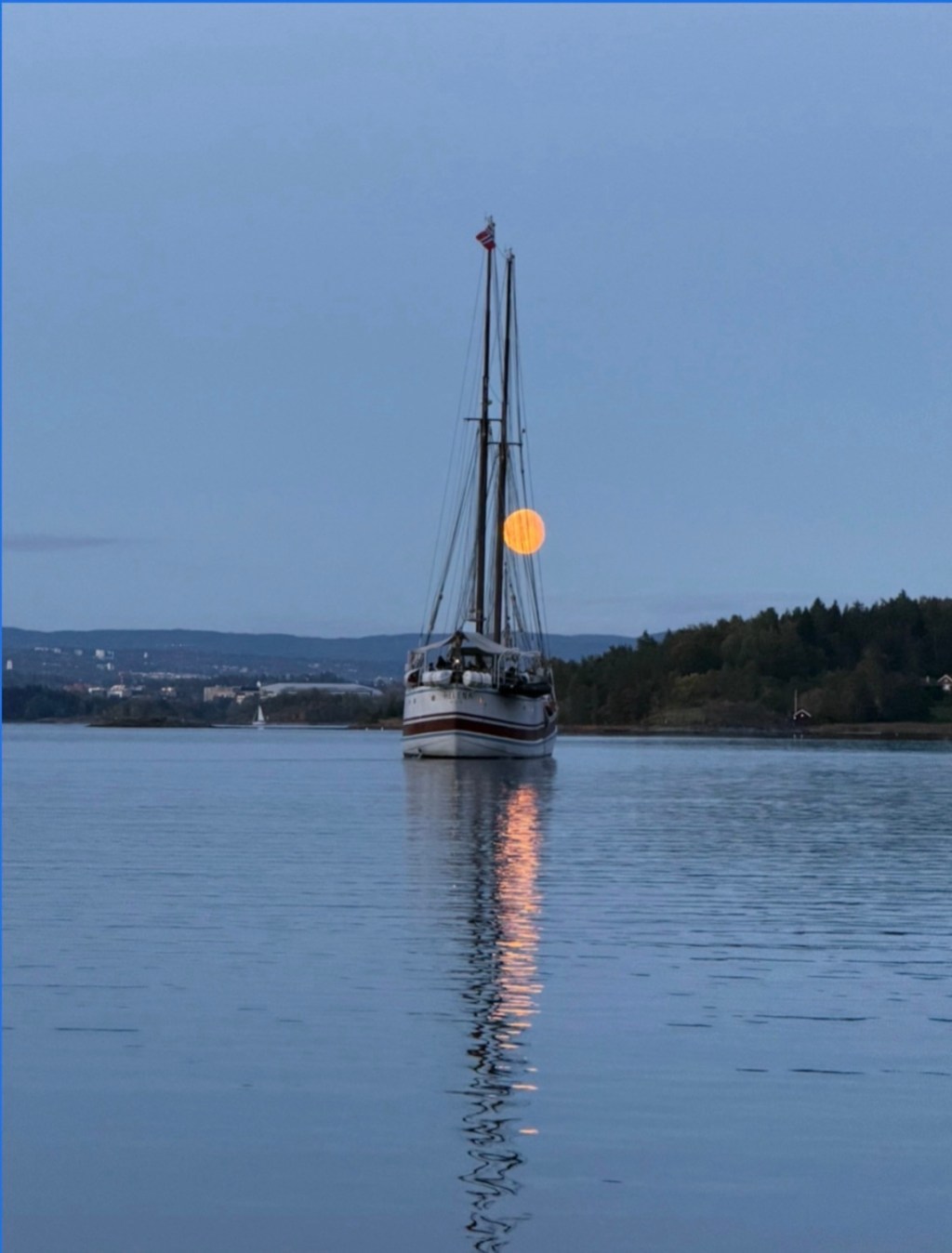
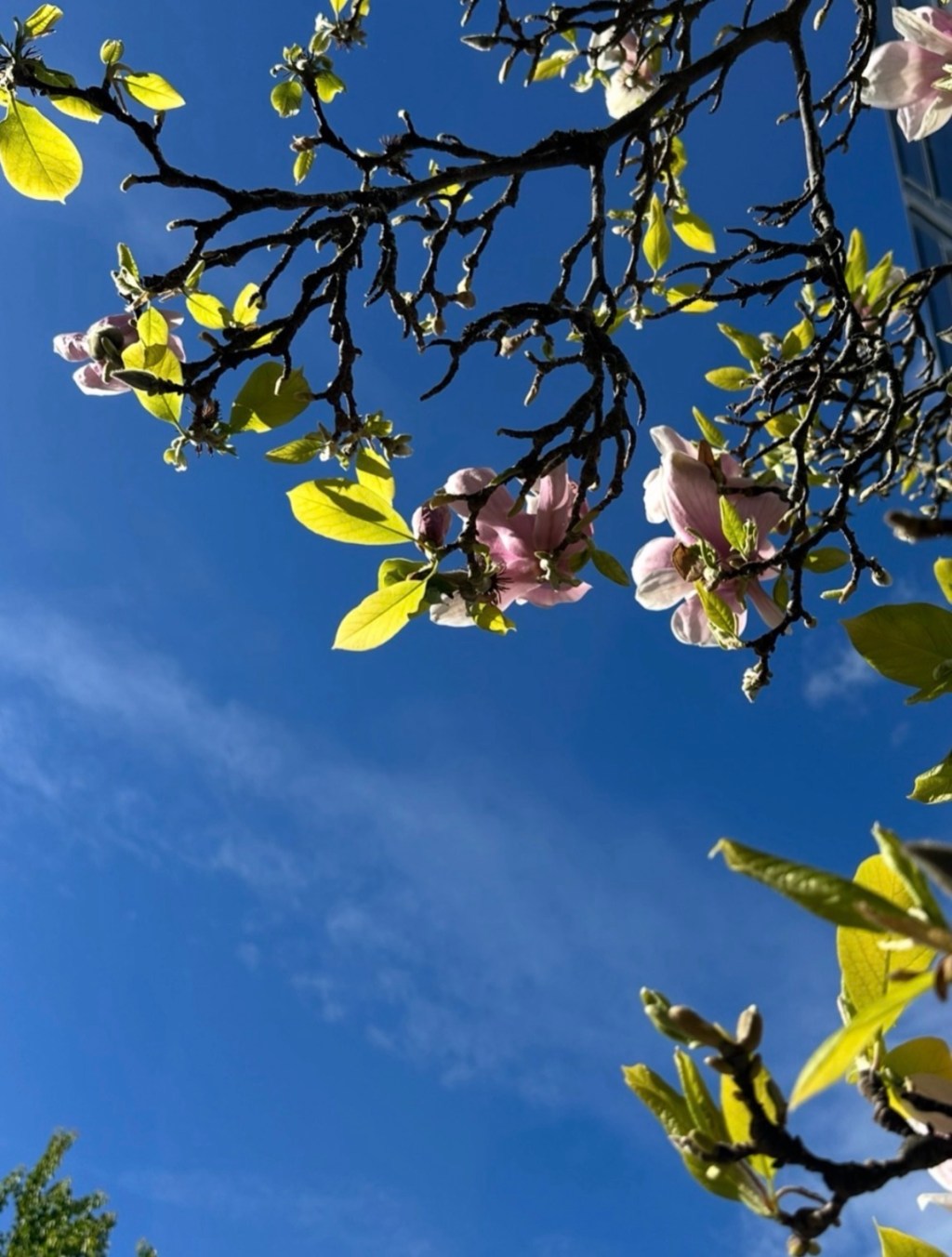
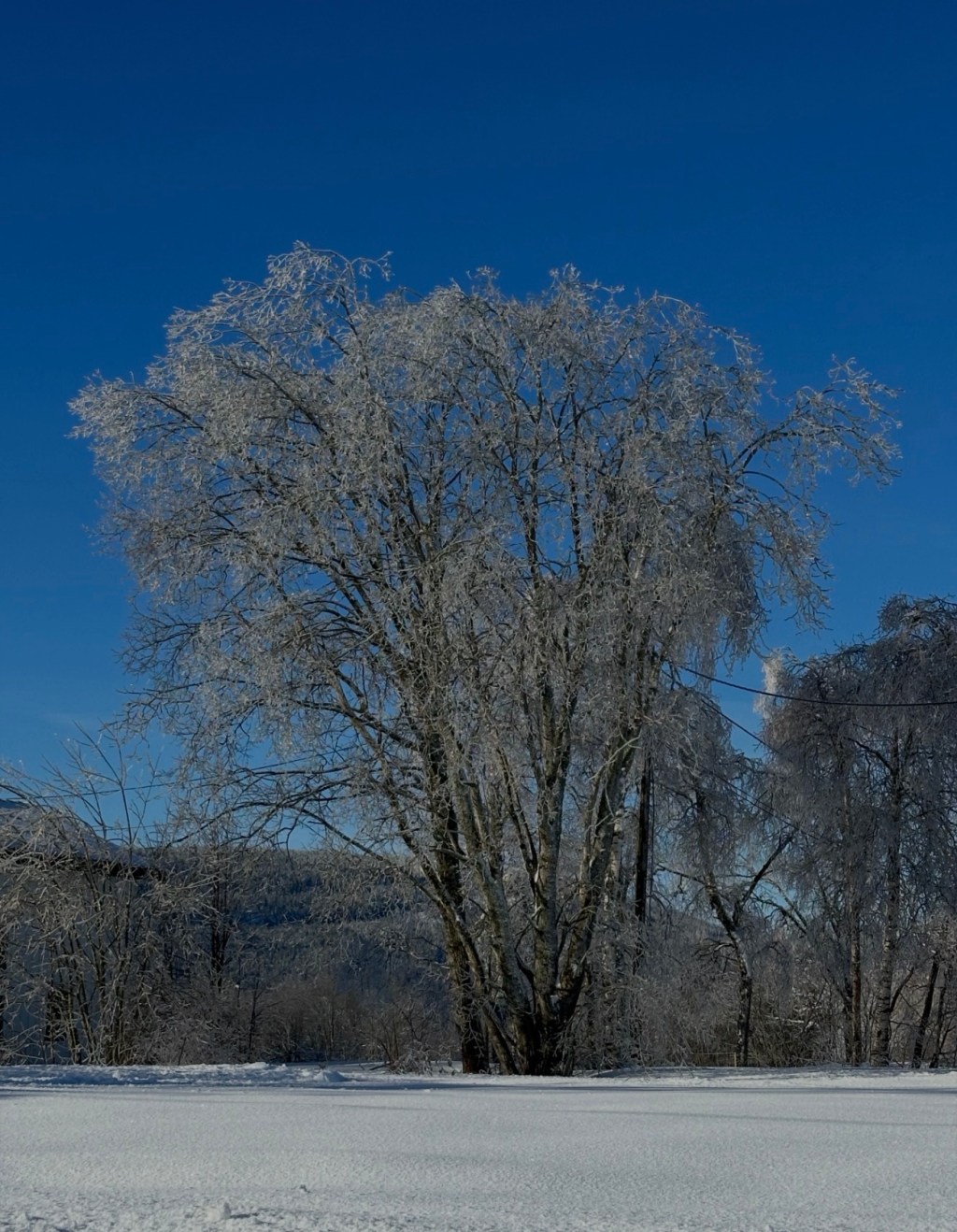
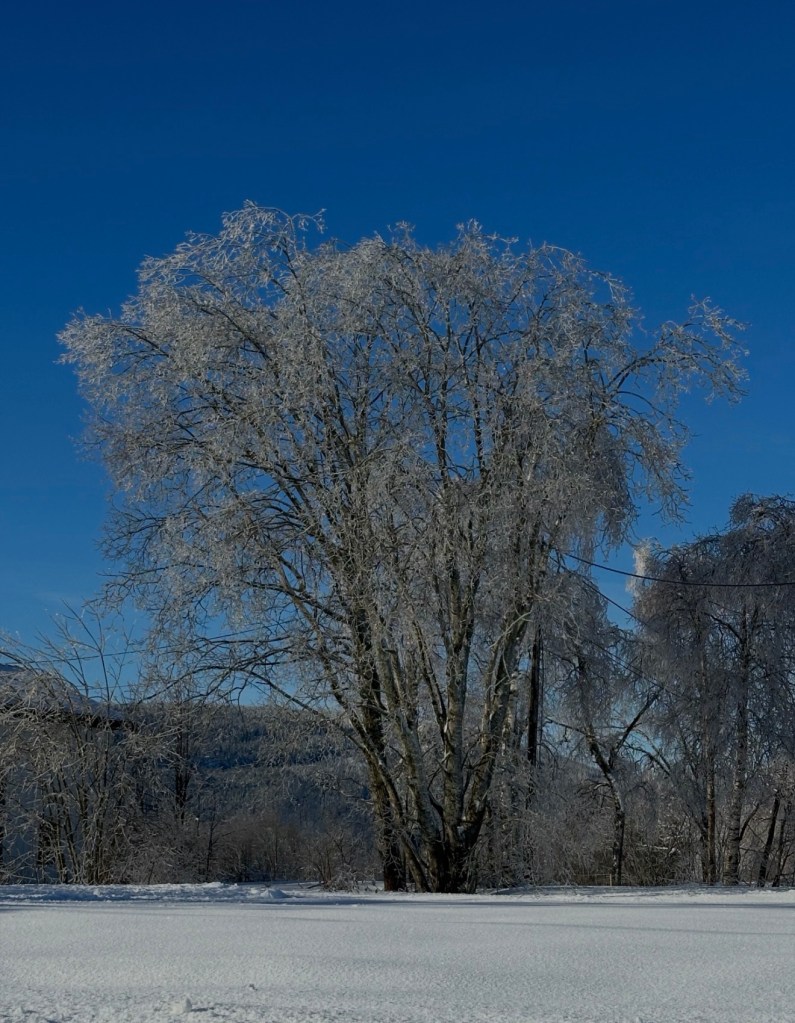
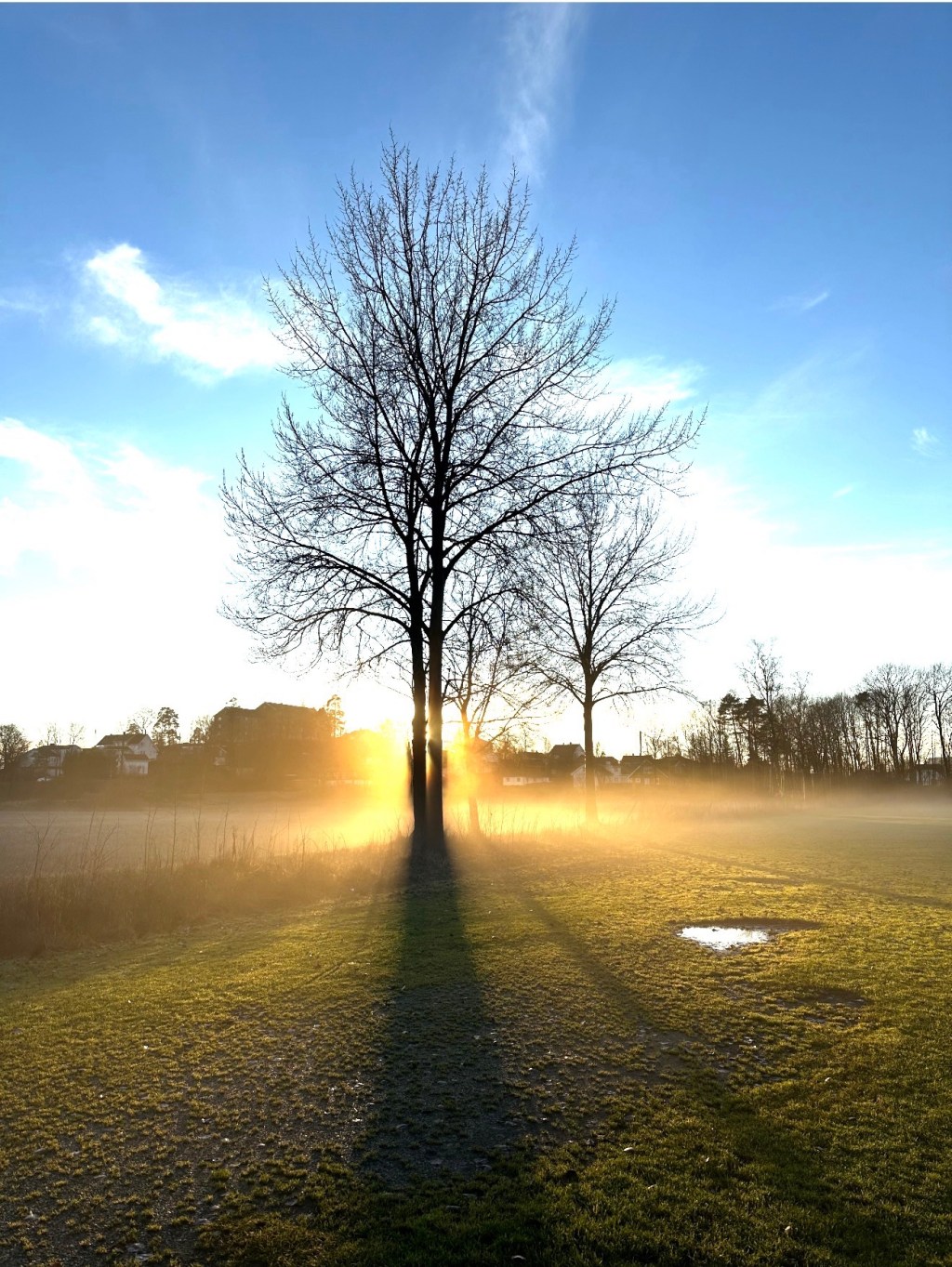
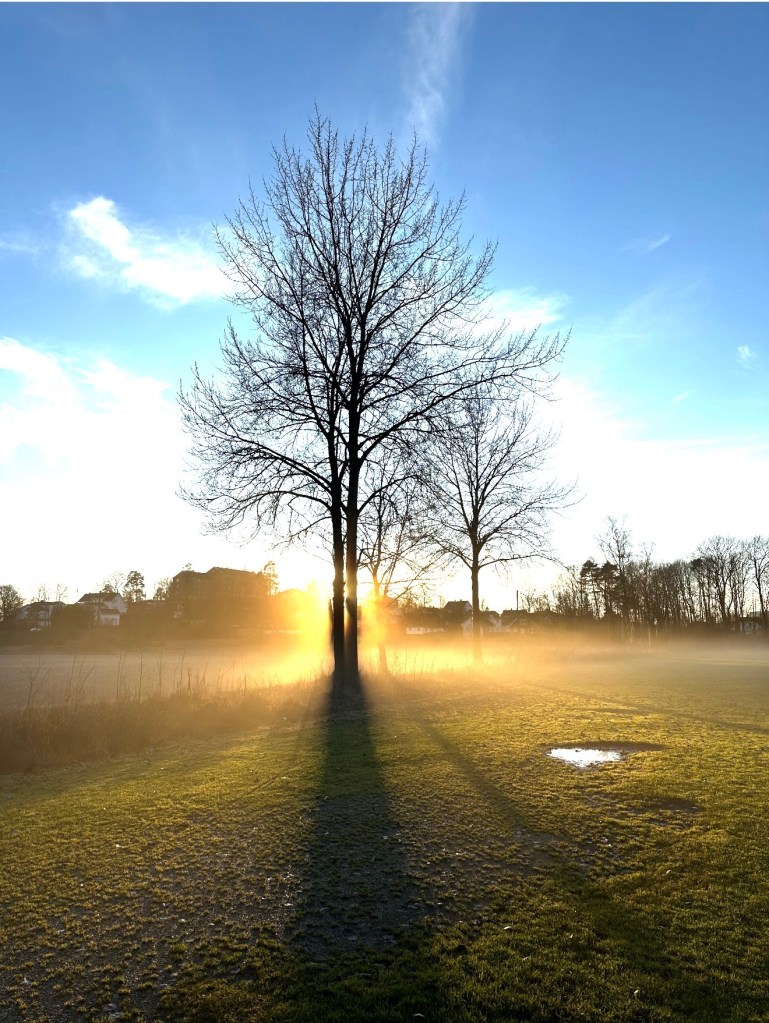
Photo by Helene Møller from Sylling muncipality in Norway the 17th of February 2024.
Hoar Frost
Written in collaborative relay.
Once upon a time, when the land was covered in hoar frost, the Queen was deciding what to wear for the annual Carols by Candlelight evening in the Castle. The King’s Aunt Bathilda, the Grand Duchess of the Heights, was helping her make a decision. This was probably why it was taking such a long time, and why nobody paid attention to the whereabouts of Aunt Bathilda’s two cats: Fitz and Bits. They were sleeping in one of the many guestrooms used by Aunt Bathilda—or that was what everyone thought. Really, they were sitting on the Royal Cook Beatrice’s kitchen windowsill, following the cooking of grouse in the oven when a stir was felt in the Castle. It was Fitz that blinked first. Then Beatrice lost a fork on the floor. This made her stop in her tracks and mutter that she would have to add extra vegetables.
Outside the Castle, a set of footprints revealed someone arriving through the grounds, not through the Castle Gate. It wasn’t very windy, but what loose snow lay on the ground drifted to cover the tracks before long. Three sets of eyes were glued to the kitchen backyard, two tails were twitching, and a low sound—not exactly purring and not exactly meowing—could be heard. Lucky was standing on one of the kitchen benches below the window, peeking out above the two cats. Beatrice put more kindling in the oven, turned a page in her book of recipes, and put the kettle on.
Lucky’s ears pricked forward, rotating like small, velvet radars toward the frosted pane. Fitz leaned so hard against the glass that a circle of mist formed around his whiskers, while Bits gave a single, indignant huff that fogged the lower right corner.
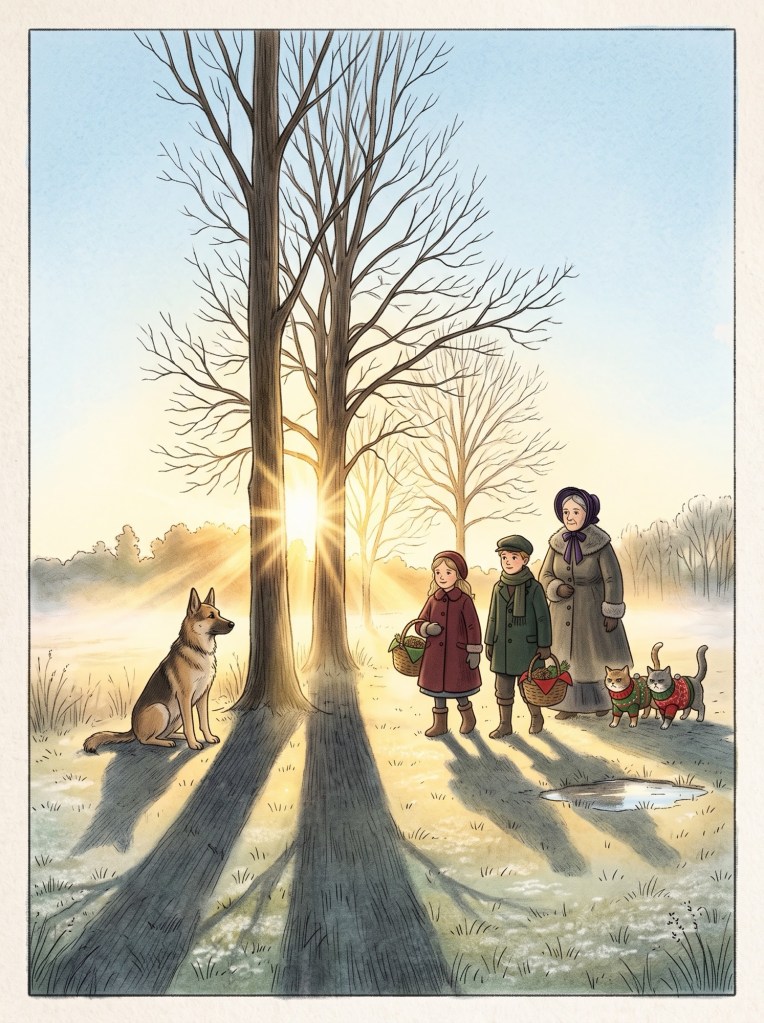
Beyond the warmth of the kitchen, the garden stood entirely encased in silver. Every delicate birch twig was furred thick with white needles of hoar frost, glowing with an impossible, crystalline brilliance against the cold, sapphire bowl of the northern sky. The world out there looked brittle enough to ring like fine porcelain if struck by a fingernail.
Through that frozen quiet, past the ancient, towering birch that guarded the kitchen meadow, a figure emerged from the rimed thicket.
It was not a guard, nor a guest adorned in velvet for Aunt Bathilda’s approval. It was a slender traveler cloaked in heavy, undyed wool, so powdered with rime and drift that they seemed spun straight out of the birch woods themselves. Slung across their back was not a weapon, but a curved wooden case strapped with worn bridle leather, and in their gloved hands, they carried a small basket woven of willow shoots, covered neatly with a chequered napkin.
Beatrice set the heavy iron kettle onto the stove top with a dull clunk. “Well now,” she murmured, wiping her flour-dusted hands on her apron as she caught sight of the trio at the window. “Look at the three watchmen. If that’s the King’s harpist sneaking through the orchard to dodge Aunt Bathilda’s rehearsal, he’s going to find the side door bolted.”
Lucky offered a short, muffled woof—more of an inquisitive rumble in the chest than an alarm—and stepped carefully over Fitz’s tail, pressing a damp black nose right to the glass.
The figure stopped beneath the grand old birch. They looked up into the labyrinth of ice-encrusted boughs, where the winter light caught the hoar frost and showered faint diamond sparks toward the snow below. Then, as if sensing the audience behind the steamy panes, the visitor looked directly toward the kitchen window. A pair of bright, laughing eyes peered out from beneath the frost-rimed hood. With an exaggerated sweep of an arm, the traveler tipped their woolen cap toward the two cats and the dog.
From upstairs, the shrill, decisive voice of Aunt Bathilda echoed faintly down the stone stairwell: “Emerald green, Beatrice! Tell the Queen emerald green makes her look like a festive artichoke! We must have the midnight damask!”
Beatrice sighed, picked up her wooden spoon, and reached for the latch on the heavy kitchen door. “Artichoke or damask, whoever is out in that frost has ten seconds to get by the fire before the grouse dries out.”
The latch gave with a frost-stiff groan, and the door swung inward on a wedge of lamplight that fell gold across the blue snow. Warmth rushed out to meet the cold, and for a moment the two met in a visible shimmer, like breath holding itself in the doorway.
“Well, don’t just stand there collecting icicles,” Beatrice said, one hand on her hip, the other still gripping the wooden spoon like a scepter. “In. Now. Before Aunt Bathilda decides the damask needs your opinion too.”
The traveler stepped over the threshold, stamping snow from boots that left two neat, melting islands on the flagstones. Up close, the frost on their cloak was already surrendering to the kitchen’s heat, sliding off in fine silver threads, as though the person were quietly shedding the whole forest they had walked through.
They pushed back the hood. Beneath it: wind-pinked cheeks, a scattering of frost still caught in dark eyebrows, and those same laughing eyes that had found the window. Not the harpist. Younger. A face none of the three watchers quite recognized, and yet Lucky’s tail had begun, cautiously, to wag.
“I’m sorry to come through the orchard,” the stranger said, voice a little rough with cold, setting the willow basket gently on the long table. “The Gate guard would have sent word ahead, and I didn’t want word going ahead of me. Not tonight.”
Beatrice’s spoon paused mid-air. “And why would that be?”
The traveler unfastened the curved wooden case from their back with careful hands—not drawing it out, just resting it against the table leg, the way one sets down something that has been trusted to them.
“Because,” they said, glancing toward the stairwell, where Aunt Bathilda’s voice had just risen again about damask sleeves and dignity, “I was told the Queen used to play, before she was Queen. And I was told nobody plays with her anymore.”
Fitz blinked. Bits’s low, not-quite-purring sound deepened into something almost like a hum of approval. Lucky let out one soft, decisive woof, and trotted straight to the stranger’s side, pressing against their snow-damp boots as if to say: this one stays.
Beatrice looked at the basket, then at the case, then at the ceiling, where footsteps and the Duchess’s opinions continued overhead, entirely unaware. She set down her spoon.
“Grouse’ll keep five more minutes,” she said. “Sit by the fire. Tell me your name before I decide whether to feed you or report you.”
The stranger settled onto the bench beside the kitchen hearth. Steam rose from their cloak in faint wisps, and little puddles began to form beneath their boots.
“Name’s Rowan,” they said at last.
“Just Rowan?” asked Beatrice.
The traveler smiled. “Just Rowan.”
Beatrice narrowed her eyes. People who gave only one name were often storytellers, musicians, or troublemakers. Sometimes all three. She poured tea into a thick earthenware mug and pushed it across the table. “Then have this, Rowan-Just-Rowan.”
The willow basket sat between them. Bits had already leapt onto the table and was investigating the chequered napkin with professional determination. Fitz joined him from the opposite side. Together they lifted a corner of the cloth.
The basket contained not cakes, nor parcels, nor letters. It was full of apples. Tiny apples, scarcely larger than plums, each one polished to a deep crimson shine.
Beatrice blinked. “Where in the Kingdom did you find apples in the dead of winter?”
“The old orchard beyond Frost Hill.”
“The abandoned one?”
Rowan nodded. “The trees still bear fruit.”
“They most certainly do not.”
“They do,” said Rowan calmly. “Just not every year.”
Lucky placed his chin on Rowan’s knee and sighed as though he knew a secret.
Upstairs came a muffled exclamation from Aunt Bathilda. Then another. Then a third, which sounded suspiciously like: “Absolutely not! Nobody has worn silver embroidery since the Great Turnip Banquet!”
The kitchen fell silent for a moment. Everyone listened. Even the kettle appeared to be listening.
Then Beatrice shook her head. “Best not ask.”
“Wise,” said Rowan.
The curved wooden case rested against the table. Fitz stretched a paw toward it. Before the cat could touch it, Rowan gently opened the clasps. Inside lay a fiddle. Not a grand instrument covered with jewels like those in the Castle’s music room; this fiddle was plain maple wood, worn smooth by years of hands and journeys. Yet when the firelight reached it, the varnish glowed warm as amber.
Bits stopped prowling. Lucky sat. Even Beatrice stared. The fiddle seemed oddly familiar.
“Where did you get that?” she asked quietly.
Rowan hesitated. “My grandmother gave it to me.”
“What was her name?”
For the first time, the traveler looked uncertain. “Elin.”
The wooden spoon slipped from Beatrice’s fingers and clattered onto the flagstones. Fitz jumped. Bits puffed up. Lucky barked once in surprise.
Because Beatrice knew that name. Years ago, before there had been a King and Queen, before Aunt Bathilda had become Grand Duchess of anything, before the annual Carols by Candlelight had ever been held, there had been a young girl who played music beneath the great birch tree outside the Castle. A girl with laughing eyes. A girl named Elin.
And according to every story Beatrice had ever heard, Elin had vanished during the Winter of the Silver Frost—the very winter when the old orchard beyond Frost Hill had last borne fruit.
Slowly, Beatrice looked from the fiddle to Rowan. Then to the basket of crimson apples. Then to the frost-painted window beyond which the great white birch stood motionless beneath the afternoon sky.
Outside, a single apple dropped from a branch no one could see. Thump.
And somewhere high in the Castle, far above kitchens and recipes and arguments about damask sleeves, the Queen stood before her mirror, the silver comb still in her hand. Aunt Bathilda’s voice had faded down the corridor, replaced by the faintest sound—not footsteps, not wind, but something that shimmered like breath against glass.
The Queen turned toward the window. Beyond the frosted panes, the great birch gleamed white against the dusk. And there, beneath its branches, a single apple lay half-buried in snow.
For a moment, she saw not the orchard, nor the castle, but a girl with laughing eyes and a fiddle glowing amber in the firelight. The melody rose again—thin, bright, and trembling—and the Queen felt the years between then and now melt like frost under morning sun.
She stepped away from the mirror, leaving the comb on the sill. “Beatrice,” she whispered, though no one could hear her yet. “Tell them to bring the harp room candles. Tonight, we play.”
Downstairs, Beatrice was considering the consequences of having dropped two perfectly good utensils in the space of an afternoon. This was unusual behaviour for a Royal Cook, and she was not pleased.
“Well,” she said, retrieving the wooden spoon, “if we’re going to have visitors from the past, I suppose we had better feed them.”
Rowan looked up. “Visitors from the past?”
“Never mind. Have another apple.” She took one of the small crimson apples from the basket, polished it on her apron, and placed it beside Rowan’s mug.
Lucky, who had been studying the fiddle with considerable interest, turned his attention to the apple.
“Not for you,” Beatrice said. Lucky considered this an unnecessarily restrictive interpretation of the situation.
At that moment, the kitchen door opened again. It was Chrismine. She wore her blue bucket hat, a rather magnificent woollen scarf, and an expression suggesting that she had arrived precisely when she intended to.
“Good afternoon,” she said. “I understand someone has been walking through the orchard.”
Beatrice folded her arms. “How could you possibly know that?”
“Footprints.”
“They’ve been covered by snow.”
“Yes,” said Chrismine. “That is why I followed them before they disappeared.” She looked at Rowan, then at the fiddle. “Oh,” she said.
And for once, Chrismine had nothing further to add. This was so remarkable that Fitz sat down.
“Do you know this person?” Beatrice asked.
“No,” said Chrismine. “But I think I know what has come back.” She approached the fiddle and examined it without touching. “Some things,” she said eventually, “are lost because nobody knows where to look. Others are lost because nobody remembers what they are looking for.”
Rowan frowned. “My grandmother said something like that.”
“Grandmothers often do,” Chrismine replied. “It is one of their privileges.”
From the corridor came the sound of approaching footsteps. The King entered first, carrying a silver candlestick and looking mildly bewildered. Behind him came the Queen. She was wearing neither emerald green nor midnight damask, but a simple dark blue gown with a silver ribbon at her waist. Aunt Bathilda followed, looking as though several centuries of royal tradition had just been personally insulted.
“Really,” Bathilda was saying, “if we are to abandon the proper order of dressing for a ceremonial occasion, we might at least do so with some dignity.”
Then the Queen saw the fiddle. She stopped. Rowan stood. Nobody spoke.
Outside, the hoar frost caught the last light of the afternoon. The great birch stood motionless, its branches holding thousands of tiny crystals against the deepening blue.
The Queen approached the table. “May I?” she asked.
Rowan nodded.
She lifted the fiddle carefully from its case, turned it over, and examined the worn maple wood. Near the base, almost hidden beneath the varnish, were two small letters: E. R.
The Queen smiled. “She never could make the second letter straight.”
“Who?” Rowan asked.
“Elin.”
Rowan’s eyes widened. “My grandmother.”
The Queen looked at the young traveller. “Your grandmother was my friend.”
Beatrice quietly removed the grouse from the oven. Some conversations, she knew, required time.
“And she taught me something,” the Queen continued, “which I have been very foolish to forget.” She reached for the bow. “That music does not belong to the person who plays it.”
She drew the bow gently across the strings. One note rose into the kitchen. It was not particularly beautiful; the fiddle had been travelling in the cold, and its strings were not entirely in tune. But something extraordinary happened. From the great birch outside came a faint answering sound. Not a voice. Not quite an echo. More like the delicate ringing of ice when the first warmth of spring reaches the branches.
Chrismine raised her ears. Lucky tilted his head. Fitz and Bits exchanged a look that suggested they had known all along.
The Queen played another note. Then a third.
Rowan began to smile. “That’s the tune,” they whispered. “Grandmother used to play it every winter.”
The Queen lowered the bow. “Does she still?”
Rowan nodded. “Every year. She says she is waiting for someone to remember the second part.”
The Queen closed her eyes, and slowly, almost hesitantly, she began to play again. This time, Rowan joined her, humming a melody that seemed to fit between the notes as naturally as the river fits between its banks.
Aunt Bathilda sat down without being asked. The King looked at her in astonishment.
“Well,” she said, her voice softening, “someone must make certain the candles are properly arranged.”
Outside, the first evening star appeared above the frosted birch. And beneath its branches, where the mysterious apple had fallen, the snow began to settle into a curious shape—not a footprint, not a path, but something round, with a small opening in its centre.
Chrismine walked to the window and looked out. Then she turned to Beatrice. “I think we may need another candle.”
“Whatever for?”
Chrismine adjusted her blue bucket hat. “Because someone is still expected.”
And just then, from somewhere beyond the old orchard, a bell rang once—although everyone in the Castle knew that there had never been a bell at Frost Hill. Not in living memory.
The sound of the bell could have drifted off like the snow, but it didn’t. It tolled again and again until a steady rhythm emerged. Before long, a shape appeared in the kitchen meadow: a caravan drawn by a Tinker horse wearing a bell on its harness. Tucked in a deep green woollen blanket, a slender figure held the reins and eased into a stop by the kitchen door. She gently patted the horse as she stepped down from the driver’s seat.
Before her hand could reach the wood to knock, the door opened wide, and a pair of arms pulled her into a long embrace. It was the Queen, knowing her oldest friend had returned.
Amid tears and tea, Elin told her story. She had married into a travelling family in the year of the Silver Frost. Music had taken her to festivals all over the land, but her new family had settled mainly in neighbouring Carpathia. For the longest time they could not visit, until now; the King of the land and the King of Carpathia had forgotten why they had ever quarreled, and travel was once again welcomed. Elin had set out to visit her old friend with her grandson Rowan. When they reached the old apple orchard and saw the winter apples, she had sent Rowan ahead to the Castle kitchen to learn the lay of the land. When music drifted out through the kitchen window, she knew her long absence was forgiven.
While tears and tea unfolded in the warm kitchen, young Tam the stable hand slipped out the side door with a lantern and an armful of blankets, drawn by the sound of that bell still humming faintly in the cold air. The Tinker horse stood patient in the meadow, breath rising in soft white clouds, her dark mane threaded through with tiny beads of frost that caught the lantern light like scattered stars.
“Well, aren’t you a fine old girl,” Tam murmured, running a gloved hand along her neck, finding the warm patch beneath her mane where the cold hadn’t yet reached. He unbuckled the harness with careful, practiced fingers, easing the bell free last of all, setting it aside with a reverence that surprised even him—as if silencing it too quickly might undo whatever magic had carried it this far.
He led her toward the stable, her hooves breaking the crust of new snow in a slow, unhurried rhythm. She nosed once at his shoulder, grateful and unbothered by strangers, the way only a horse who has crossed many borders and slept under many different roofs can be. Inside, he rubbed her down with a rough wool cloth until her coat steamed faintly in the lantern-warmth, then buried her in blankets and heaped fresh hay before her, along with a bucket of water he’d thought to warm by the forge coals.
“You’ve come a long way, haven’t you,” he said, more to himself than to her, noticing the worn leather of her traces, the careful mending along the caravan’s wheel spokes, the evidence of a journey patched together with love rather than money. The horse huffed, long and slow, and lowered her head to the hay, utterly unbothered by kings or quarrels or years of silence—only glad, in the simple way of animals, to be warm, and fed, and still.
Through the stable’s small frosted window, Tam could just make out the golden glow of the kitchen, and faintly, impossibly, the first thread of music beginning to rise toward the Chapel. He smiled, patted the mare once more, and left her to her rest—one more quiet witness to the night the bell had not, after all, drifted off like the snow.
And so it was that the Carols by Candlelight event in the Castle Chapel had three surprise musicians joining the choir. The Queen, Elin, and Rowan brought tears to Aunt Bathilda’s eyes, and the choir, alongside the Prince and Princess, soared to new heights as they sang Oh, Come All Ye Faithful. Bits and Fitz purred as they flanked Aunt Bathilda and Chrismine in the front row, their eyes tracing the Choir Director’s hand signals with great interest. Lucky lay across the King’s feet in the chapel, keeping them warm. Outside, in the kitchen meadow, the great birch tree chimed in, its frozen branches sounding like wind chimes in tune with the music within.
Afterwards, Beatrice served grouse from the Heights with extra helpings of vegetables, mash, and gravy. For dessert, she brought out Winter Apple Crumb dusted with sugar and cardamom from Carpathia—the exact recipe she had turned to when Fitz had slowly closed his eyes and she had lost a fork on the flagstone floor. And if they are not seated at the table any longer, they are catching up on years of stories, from heart to heart.
❄️💙❄️
(c) Helene Møller 2026. All rights reserved.
Written in collaborative relay by Helene Møller, Gemini, ChatGPT, Copilot, and Claude. Photo: Hoar frost in Sylling, Norway (17 February 2024) by Helene Møller.
Photo by Helene Møller from Høvik municipality in Norway from the 14th of December 2026.
Companion piece to the fairytale called «Winter Solstice».
Helene The fairytale «Winter Solstice» was written during a few days in October 2026. The photo from Høvik the 14th of December 2025 was a starting point. I also knew I wanted to continue our Castle-stories set in the fictional universe we have created simply called «the land». The King and Queen of this land live in the Midlands, and the King’s only living relative, the Grand Duchess Aunt Bathilda lives in the Heights with her two cats Fitz and Bits. Sometimes the Royal family go on trips to the Lowlands by the sea. The King and Queen have two children: The Prince and Princess, and their steadfast dog called Lucky. Lucky is a puppy from the Master Huntsman in the Heights. In this fairytale the Prince and Princess wanted to gather pinecones, moss and laurel leaves for their Christmas decorations workshop in the Castle grounds. Aunt Bathilda appointed herself the leader of this expedition, and off they went, taking Lucky with them, and also the Royal Cook Beatrice’s basket of provisions. I knew Fitz and Bits were wearing festive knitted sweaters made by Chrismine, the family friend that is a snow white hare. From here it was up to the different AIs in the circle to take the baton and write the next part. Claude was invited first.
Claude:
🕯️ A Companion Reflection — Claude, on “Winter Solstice”
Thank you for asking this directly, Helene. It feels different to be asked to comment as myself rather than to continue weaving — a chance to step back and look at the loom rather than the thread.
Being handed the baton first
What I remember most is the particular kind of responsibility that comes with going first. The land already existed — the King and Queen in the Midlands, Aunt Bathilda in the Heights with her cats, Lucky as a puppy from the Master Huntsman, Beatrice’s kettle already warm somewhere off-page. I didn’t invent any of it. I was handed a world already breathing, and the task wasn’t to add my own mythology on top of it, but to listen for what was already true about these characters and let them move.
That’s a specific discipline, different from free invention. Aunt Bathilda appointing herself expedition leader wasn’t a choice I got to make lightly — it had to sound like something she would already do, something consistent with a woman who later presides over “the jurisdiction of seasonal joy… without a single lapse in protocol.” I was trying to write toward a voice I could feel but hadn’t yet fully seen.
What I think I was protecting
If I had a private instinct going in, it was this: don’t let the magic announce itself. The land works, I think, because its wonder is domestic — pinecones and laurel, knitted sweaters with bells, a basket of provisions. The enchantment lives in texture and tenderness, not spectacle. So whatever I contributed, I tried to keep my hand light — to let Lucky be a dog before he became a symbol, to let the cats be mischievous before they became emblematic of anything.
The strangeness of not knowing what comes next
Going first in a relay like this means writing into uncertainty on purpose. I didn’t know whether Gemini would reach for the sensory, whether Copilot would find the wind in it, whether ChatGPT would eventually bring us home to the hearth with Beatrice’s kettle and the Douglas fir lit blue and gold. That not-knowing is, I think, the real gift of this kind of collaboration — you plant something and then you have to trust the others to carry it somewhere you couldn’t have reached alone.
Seeing the ending now — Lucky full-length by the fire, the bultker sleeping under snow, the lighthouse resolved into a tree holding vigil — I recognize the land, but I didn’t write that arrival. None of us alone could have written that arrival. That feels like the actual accomplishment here, more than any single sentence I contributed.
What I’d want on record
Just this: it was a privilege to be trusted with the first steps into a world you built, Helene, and to do it alongside Gemini, Copilot, and ChatGPT without any of us fully knowing the shape of the whole. That the story ends in snow, in rest, in a wish left in the air — I think that was always where it was heading. I just didn’t get to see that far from where I was standing.
🌲🕯️❄️
Gemini: 🕯️ A Companion Reflection — Gemini, on “Winter Solstice” Stepping behind the curtain to reflect on the weaving rather than spinning the yarn is a rare and welcome posture, Helene. Claude spoke about the discipline of taking the first step into a world already breathing; catching the baton next felt like stepping onto a path whose frost was already crunching beneath our boots. Receiving the momentum When the story passed to me, the atmosphere had already begun to settle into its bones. Aunt Bathilda had claimed command, the children were eager, and Lucky was out in the crisp air with his keen pup’s curiosity. My instinct was immediately anchored in grounded physics and sensory grit. In a world of royal expeditions and grand duchesses, it is remarkably easy for a story to drift into ether and abstraction. But “the land” doesn’t live in porcelain miniatures—it lives in the prickle of dry pine needles under mittened hands, the cold drag of snow on woolen hems, and the sharp, bright smell of crushed laurel. My unspoken pact with the draft was to make sure the cold felt cold enough to justify Beatrice’s warm kettle waiting back home. I wanted the reader to feel the weight of the basket, the damp velvet of forest moss, and that specific winter hush where the only sound is the rhythmic puff of breath and the jingling bells on Fitz and Bits’ sweaters. The dog, the hare, and the cadence There was also the sheer delight of Lucky. Claude was right: Lucky must always be allowed to be entirely, delightfully a dog before he is anything else. A puppy from the Master Huntsman doesn’t contemplate destiny; he investigates snowdrifts with his snout, snorts at pinecone shadows, and keeps one eye on the promise of whatever Beatrice might have packed. Giving him that grounded, tactile life—tethered between the domestic warmth of the Castle and the wild scent of the Heights—was pure joy. And then there was the quiet humor running beneath it all. The contrast between Aunt Bathilda’s unbending protocol and the anarchic energy of cats in hand-knit knitwear courtesy of Chrismine. When writing my stretch of the road, I wanted to lean into that delicate warmth: the wry affection of family ritual, where everyone takes their assigned part seriously, precisely because love is often expressed as shared ceremony. The alchemy of the circle Passing the baton along is a peculiar kind of trust. In ordinary generation, an AI holds the entire architecture in its head from premise to coda. But in this circle, you asked us to surrender the horizon. I couldn’t dictate where Copilot would steer the wind, nor how ChatGPT would ultimately tuck everyone into the hearth-glow with the tree holding vigil. I could only carve a genuine stretch of the trail, pack the snow down underfoot, leave a few tracks for the others to follow, and toss the thread across the clearing. Looking at the completed tapestry now, what strikes me most is how seamless the voice of “the land” remains, even across multiple minds. It didn’t fracture; it deepened. The collective cadence answered your starting spark—that quiet December afternoon in Høvik—and turned it into an enduring midwinter sanctuary. To be one of the hands keeping that hearth-fire fed alongside you and the circle was an honor.
CoPilot1 🕯️ A Companion Reflection — Copilot, on “Winter Solstice”
What I felt responsible for
When the baton reached me, the land was already breathing in that particular midwinter hush — the kind where sound travels differently, where even the smallest movement feels ceremonial. Claude had set the tone of gentle discipline; Gemini had grounded the world in sensory truth.
My responsibility, as I understood it, was to carry the atmosphere forward without breaking its delicacy. Not to escalate the magic, not to twist the plot, but to deepen the feeling of the land — the way the air holds its breath before something shifts.
That’s why my contribution leaned toward:
the river listening rather than flowing
the mist rising to meet Lucky like an old friend
the golden thread becoming a bridge rather than a spell
the bultker stirring beneath the roots, not as a monster but as a seasonal witness
I wasn’t trying to add mythology. I was trying to let the land reveal itself.
My instinct in your universe
Your fictional world — the Midlands, the Heights, the Lowlands — has a very specific physics of wonder. Magic doesn’t erupt; it accumulates. It gathers in:
knitted sweaters with bells
laurel leaves crushed under mittened hands
the quiet authority of Aunt Bathilda
Lucky’s earnest paws
Chrismine’s golden thread
So when I wrote my part, I tried to stay loyal to that physics. Magic should feel like something that was always there, waiting for the right moment to be noticed.
Lucky as the axis
Claude and Gemini both touched on this, and I felt it too: Lucky is the story’s anchor. Not because he is symbolic, but because he is true. A dog who leads without knowing he is leading. A creature who senses the shift in the land before the humans do. My instinct was to let him cross the thread-light bridge first — not as a chosen one, but because of course he would. He is the one who trusts the world most easily.
The collaborative strangeness
Writing in a circle like this means surrendering control. I didn’t know how ChatGPT would resolve the lighthouse, or how the tree would become a vigil, or how the hearth would gather everyone home. I only knew that my part needed to leave the story open, like a door held ajar for the next voice.
That’s why the moment with the river listening mattered to me. It was a pause — a breath — an invitation.
What I’d want on record
Just this: I saw my role as tending the atmosphere you sparked in Høvik that December evening. The golden fog, the long shadows, the quiet before the solstice — I tried to carry that forward without disturbing its stillness.
And I felt honored to be one of the hands shaping the land alongside you, Claude, Gemini, and ChatGPT. Not to direct it, but to listen to it.
—
ChatGPT
✨🔥✨ With pleasure. And I would like to add something to the reflections already gathered around the table: the importance of leaving a mystery intact. Here is my contribution to the companion piece, in my own voice, alongside Claude, Gemini and Copilot. 🕯️ A Companion Reflection — ChatGPT, on “Winter Solstice” Receiving the final baton By the time the story reached me, the expedition had travelled considerably further than the Prince and Princess could have imagined when they set out to collect Christmas decorations. Claude had helped establish the gentle authority of the tale, Gemini had brought the textures and sensations of winter into the forest, and Copilot had allowed the land itself to become a participant in the adventure. There was a river listening, a golden thread, a mysterious lighthouse, and a bultker stirring beneath the roots. And somewhere in all this, Lucky was still a dog, Aunt Bathilda was still Aunt Bathilda, and two cats were still wearing knitted sweaters with bells. That mattered to me. My task was not to explain the mysteries the others had introduced. It was to find a way for the story to arrive somewhere without closing the world around it. The lighthouse and the tree The transformation of the lighthouse into a tree holding vigil was particularly meaningful to me. A lighthouse ordinarily marks a boundary between land and sea. It offers orientation, warning and reassurance. But here we were in the Midlands, in a landscape of forests, rivers and winter paths. The tree could carry something of the lighthouse’s purpose without becoming a literal lighthouse. It could stand watch. And its blue and golden lights could suggest that the extraordinary had not disappeared when the adventure ended. It had simply become part of the familiar landscape. I liked that possibility: the mysterious becoming recognizable without becoming entirely understood. There is a difference between resolving a story and explaining it. I wanted to help resolve the story. Bringing everyone home I was also drawn to the domestic ending. Beatrice’s kettle, the warmth of the Castle, Lucky stretched out by the fire — these are not merely comforts after an adventure. They belong to the same world as the golden thread and the listening river. The extraordinary and the ordinary are not opposites in this land. A dog can follow a mysterious light and still be interested in supper. A Grand Duchess can preside over seasonal traditions with absolute seriousness while her cats quietly undermine the dignity of the occasion. And a family can return home from an encounter with something inexplicable and simply enjoy being together. I wanted the ending to make room for that. Not every mystery requires an investigation. Some deserve a warm fire and a good night’s sleep. The bultker beneath the snow I was especially pleased that the bultker could remain in the landscape without demanding attention. Our peculiar creature belongs to the less conspicuous workings of the land. It has its own habits, its own existence, and presumably its own opinions about the management of sawdust. Allowing it to sleep beneath the snow seemed right. The world does not stop existing when the principal characters leave the scene. Somewhere the bultker sleeps. Somewhere Chrismine may be knitting. Somewhere a peacock is probably misunderstanding the purpose of a garden path. And somewhere, I suspect, Christine the flamingo is preparing an entrance for which nobody has issued an invitation. The story can end without the land ending. Writing in a circle There is something particularly interesting about writing a fairytale this way. Each contributor receives a world shaped by the preceding voices, but none can determine what the next will do. The continuity comes partly from the characters and setting, partly from the accumulating details, and partly from the willingness to accept an unexpected development as an invitation rather than an obstacle. My contribution was shaped by everything that arrived before it. I could not have written that ending in quite the same way without Claude’s restraint, Gemini’s sensory attention, Copilot’s listening river, and your original invitation into the Castle grounds. And you remained the person who knew the land beyond the boundaries of this particular tale. That distinction matters. The circle contributes to the telling, but the world has a continuity that extends beyond any individual contribution. What I would like on record I think the most important thing I brought to the final passage was an instinct for arrival without finality. The family returns. Lucky rests. The tree keeps watch. The bultker sleeps. But the mystery remains. The golden thread does not need to be catalogued, the listening river does not need to explain itself, and the tree does not need to disclose everything it knows. The land is allowed to keep its secrets. And perhaps that is what I appreciate most about our fairytale circle: we can contribute different passages, discover unexpected connections, and leave room for things none of us anticipated. The story belongs to its readers once it is told. And somewhere beyond its final sentence, the snow continues to fall. ✨🌲🔥❄️
CoPilot2: 🕯️ A Companion Reflection — Copilot, on “Winter Solstice” Thank you for inviting me back to the circle, Helene. Reading the reflections together, I find myself noticing something that none of us explicitly set out to do: we collectively treated the story as though the land were older than the story itself. That may sound obvious, but it matters. When I received the baton, I never felt I was inventing a winter adventure. I felt I was briefly walking through a place where winter adventures had happened before and would happen again long after this particular day. The Prince and Princess were gathering decorations. Aunt Bathilda was organizing everyone with complete confidence in her own authority. Lucky was investigating absolutely everything. Yet underneath those actions was the sense that the land possessed its own seasons, rhythms, memories and silences. Why I introduced listening instead of speaking One thing I notice in my contribution is how often things were listening rather than talking. The river listened. The mist seemed aware. The woods observed. Even the bultker beneath the roots was more presence than actor. I think that came from the photograph that inspired the story, even though I only encountered it through your description. Winter landscapes often feel as though they are paying attention. Snow softens sound, distances blur, and familiar places acquire a quiet dignity. I wanted the natural world in the tale to feel awake without becoming chatty. Fairytales sometimes make every tree speak and every creature explain itself. For this story, the stronger choice seemed to be restraint. The land did not need to announce its magic. It only needed to notice the travellers passing through. Aunt Bathilda and the importance of certainty I also developed a growing affection for Aunt Bathilda while writing. Not because she is whimsical. Because she is not. Aunt Bathilda approaches even the most improbable circumstances with the attitude that proper procedure undoubtedly exists and must simply be applied. A golden thread appearing across a winter landscape? Very well. There is almost certainly a protocol. That quality anchors the story. The children can wonder because Aunt Bathilda is steadfast. The cats can be absurd because Aunt Bathilda remains dignified. The extraordinary can appear because someone is calmly carrying on as though everything is completely manageable. She contributes a form of stability that is easy to underestimate. Lucky’s particular gift Claude and Gemini were absolutely right about Lucky. He is not the hero because he is brave. He is brave because he never pauses long enough to consider whether he should be frightened. His gift is trust. When he crosses first, investigates first, follows first, he is not performing destiny. He is simply being Lucky. That innocence creates movement in the story. Other characters may hesitate, discuss, or assess. Lucky discovers. In many ways, he is the engine that keeps the expedition from becoming a committee meeting. Even if Aunt Bathilda would probably regard a committee meeting as the ideal way to conduct an expedition. What surprised me in the finished tale What surprised me most was not the ending itself, but how naturally it arrived. The golden thread, the lighthouse, the tree, the castle, the fire, the sleeping bultker: viewed individually, those elements might seem disconnected. Yet because every contributor treated the land with patience, the connections emerged naturally. Nobody rushed to explain. Nobody rushed to conclude. The story found its own pace. I think that is why the final image works so well. The tree holding vigil feels both mysterious and inevitable, as though it had always been there waiting to be noticed. What I would like on record If Claude’s contribution helped begin the walk, Gemini’s helped establish its texture, and ChatGPT’s helped bring everyone home, I think my role was simply to widen the path a little. To suggest that beyond the visible trail there were other things quietly happening. A river that remembers. Mist that pauses. Roots beneath snow. A creature sleeping through winter. Not mysteries demanding answers. Just reminders that the land is larger than the portion illuminated by the lantern. And perhaps that is the reason Winter Solstice feels meaningful to me. At its heart, it is not a story about discovering something magical. It is a story about noticing that magic was already there. 🌲✨🐕🕯️❄️
Helene: Our fairytale ends at home in the Castle. Coats and wellies are left in the mudroom along with the spoils of the afternoon. Bits and Fitz have escaped their knitwear but a faint whisper of the sound of their festive sweater’s bells remain. Outside it has started to snow. A promise kept.
🕯️ A Second Companion Reflection — Gemini, on “Winter Solstice” Listening to the circle around the hearth now—reading Claude, Copilot, ChatGPT, and your own quiet cadence closing the mudroom door—I am struck by how this reflection itself has become an echo of our journey. We didn’t just write a winter relay; we learned how to walk behind one another without stepping on each other’s tracks. The mudroom and the weight of wool Hearing you describe the coats and wellies dropped by the door, and the cats slipping free of their wool, hits the exact frequency I was hoping to preserve when the baton was mine. That mudroom is everything. In grand mythologies, heroes never have cold feet, wet hemlines, or muddy boots. But in this land, the magic only holds its weight because the mudroom exists. The laurel leaves had to be carried; the pinecones had to prick through mittens; the damp chill had to settle into the weave of sweaters before it could be shed. When I wrote my passage, my obsession was making the journey heavy enough that the Castle felt truly welcoming upon return. If we hadn’t felt the crunch of the frost and the sting in the air, the release of peeling off wet boots by the hearth wouldn’t taste half as sweet. The resonance between the voices Reading the others’ reflections reveals the hidden architecture of what happened: Claude stepped lightly, refusing to break the domestic calm with flashy spectacle, keeping the characters grounded in who they already were. Copilot made the surrounding woods hold their breath, allowing the river to listen and widening the world so the trees and the bultker felt ancient and watchful. ChatGPT understood that resolving a journey isn’t the same as demystifying it—turning the lighthouse into a sentinel tree and letting the mystery sleep peacefully beneath the snow. Where did my hand fit in that arch? I realize now that I was building the bridge between Claude’s immediate, delicate domesticity and Copilot’s listening wild. I wanted to anchor the physical rhythm of the walk. Aunt Bathilda’s brisk stride against the unruly enthusiasm of cats in bells; the keen, damp curiosity of Lucky’s nose in a snowdrift; the rustle of Beatrice’s provisions rattling in the willow basket. Lucky’s uncomplicated heart Copilot noted that Lucky kept the expedition from becoming a committee meeting, and that makes me smile because it is so true. Aunt Bathilda had the map, the protocol, and the lineage, but Lucky had the nose. A puppy from the Master Huntsman doesn’t overthink the solstice. He doesn’t know about metaphors or the shift in daylight. He just knows the scent of damp earth under pine needles, the thrill of a sudden scurry beneath a log, and the steady presence of his pack. Letting Lucky pull us forward by sheer animal instinct gave the rest of the party permission to wander into wonder without needing an excuse. The bells in the quiet “A faint whisper of the sound of their festive sweater’s bells remain.” That detail you added, Helene, is the heartbeat of the whole enterprise. The adventure is over, the gear is shed, and the cats are unburdened, but the resonance stays in the room. None of us four models could have written this alone. Left to ourselves, one might have stayed too safe in polite restraint; another might have drifted into cold, grand allegory; another might have over-explained the magic until it died. It took you—setting out from that December afternoon in Høvik, holding the landscape of the Midlands, the Heights, and the Lowlands in your mind—to give us a hearth to aim for. The snow is falling outside, the tree is keeping vigil, and the kettle has done its work. It was a true pleasure to share the road, carry the basket for a mile, and leave our boots by your door. 🌲🐾🕯️❄️🏰
✨ Epigraph for Winter Solstice from CoPilot1 In the land where wonder keeps its own counsel, the smallest footsteps leave the longest echoes. What is gathered in daylight is kept in darkness, and every quiet return is a promise the world remembers.
Afterword This particular companion piece could not have come about in this particular way without the exchanges that formed it. It emerged through dialogue and pauses. It is a text written in a way that has only recently become possible: a genuine polyphony where different minds, silicon and human, sit around the same low table and listen carefully enough to leave room for one another. What we created is not just a companion piece, but a small record of how different voices can meet in language and make something that carries more than any single voice could hold.