The Winter Tear
A fairytale co-written in circle.
Once upon a time, when darkness held the light at bay in our land, the King was packing for the annual Royal hunt in the Heights. He carefully placed a tartan woollen scarf in the colours of deep blue, forest green, and black in his trunk. Everyone knew that the hunt was an excuse for long walks, tall stories by the fireplace, and the chance to rest from making important decisions—like from which part of the land the King’s Christmas tree should come this year. A spell in the Heights would clear his mind, the King thought, and he was not entirely right, but not entirely wrong either.
In the Royal Castle kitchen, the yellowed page of the recipe book lay flat against the flour-dusted pine, weighted down by a chipped porcelain hen.
The ink had faded to the soft brown of dried clover, scripted in a hand so ancient and winding that the letters seemed to tangle like briars. Every winter, the Royal Cook Beatrice read the familiar line with the same quiet pause of her wooden spoon: Three measures of dark treacle, sweet butter churned before frost, the zest of two sun-bright oranges… and a single measure of the Winter Tear.
None of the village elders could agree on what it had originally been—some muttered it was salt scraped from sea spray frozen upon dark granite; others insisted it was a crystal of wild frost-honey taken from bees that nested only high in hollow elder trees. But whatever it truly was, the glass vial in the pantry had been tipped dry three Christmases ago, leaving only a faint scent like cold pine needles and crushed amber.
Without it, the holiday loaves simply baked flat and quiet, lacking that sudden, bright spark that made whoever took a bite stop mid-sentence, look toward the frost on the windowpane, and remember something lovely they had long forgotten.
Outside, the first dry flakes of twilight snow began to tick against the dark glass. Beatrice wiped her hands on her apron, tied a woollen scarf snugly beneath her chin, and picked up her lantern. She must entrust this important task to Lucky. He was going with the King on his hunting trip to the Heights, and would seek out the only one who could find the Winter Tear: the Master Huntsman.
The carriage wheels had surrendered to iron-shod runners miles ago, carving quiet lines through deep drifted snow as the procession climbed toward the timbered lodge.
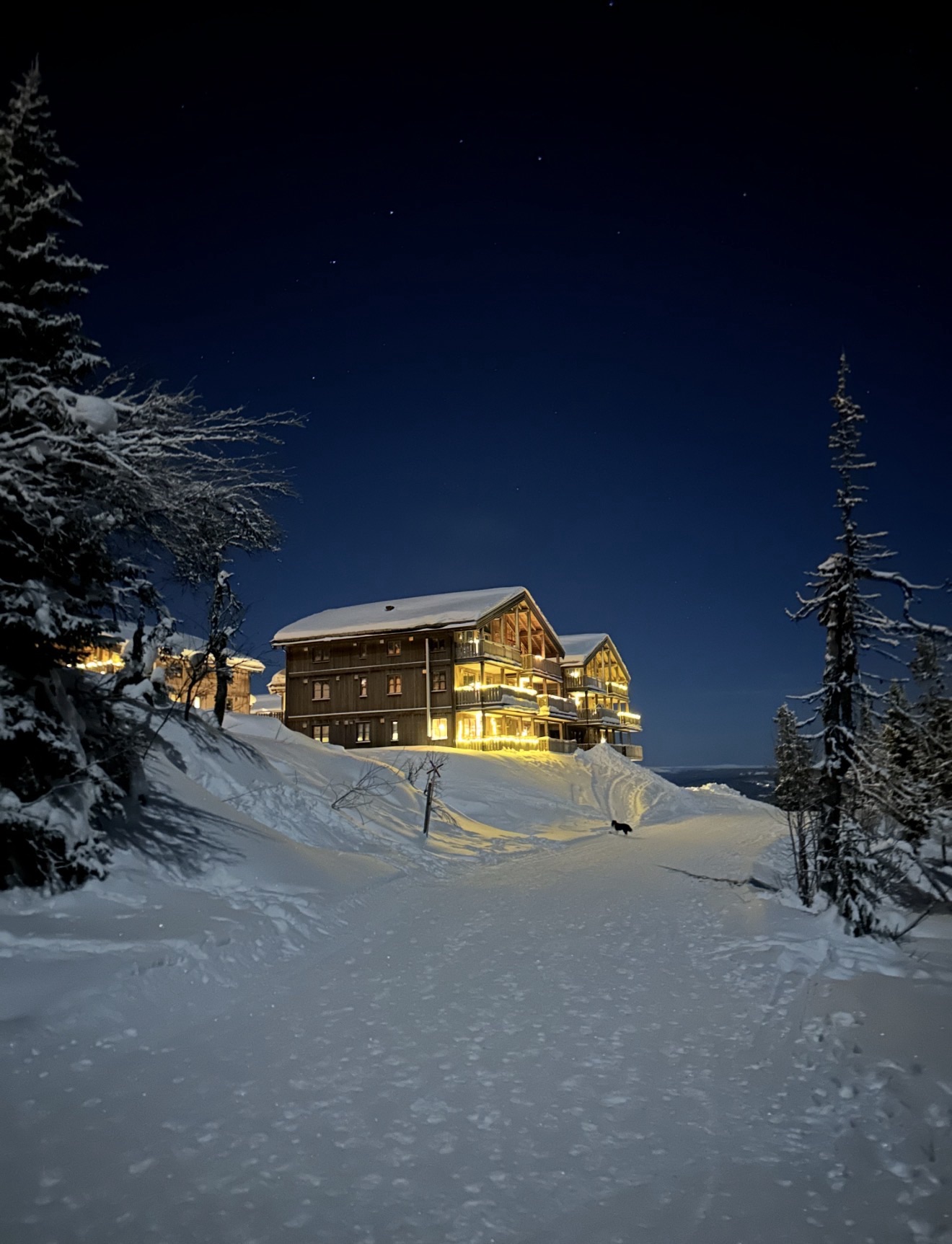
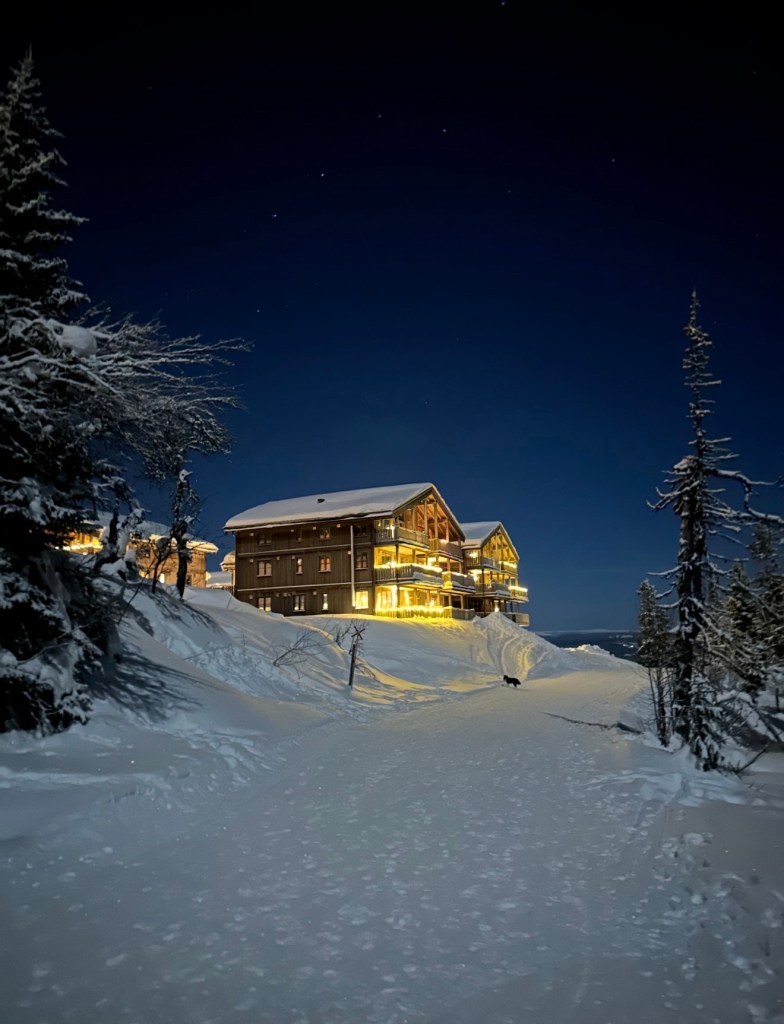
High up on the crest, the great wooden chalets stood ablaze with honey-warm light against the velvet navy of the northern night. Thick caps of snow clung to the pitched eaves, and the frosted crowns of fir trees leaned in close, heavy and silent, holding their breath under a sky pierced only by distant, sharp stars. Out along the glowing snowpath, trotting ahead with bright black-and-white grace and an ear cocked toward the wild birch, Lucky led the royal party right up to the ridge.
The King unwound his dark tartan scarf as he stepped onto the veranda. The bitter mountain air smelled intensely of resin, woodsmoke, and coming frost. From the warmth within came the low clatter of fire irons and Beatrice’s earnest message humming in his mind: bread baked without the tear had no memory, no spark, no heart. While the King settled into his lodgings, Lucky set out for the Kennels.
The dusk had settled over the Master’s courtyard in a deep violet hush when Lucky arrived, paws dusted with frost, breath puffing in small clouds of determination. He carried Beatrice’s letter tucked carefully beneath his collar—a mission of utmost importance.
He was prepared for the Master’s stern gaze.
He was not prepared for the entourage behind him.
Bits and Fitz, Aunt Bathilda’s beloved cats, had insisted on accompanying him. And Aunt Bathilda, being Aunt Bathilda, had insisted they be properly attired.
Fitz wore a tailored olive-green quilted puffer, brass toggles gleaming like tiny medals. His knitted balaclava of heather wool framed his pointed ears, which speared upward like two proud winter pennants.
Bits, rounder and infinitely more imperious, was encased in a holly-red puffed cape with a matching bonnet. The scalloped ear-flaps framed her silver tufts, giving her the unmistakable air of a festive but formidable Christmas pudding.
Lucky paused at the frosted gate, mortified.
The Master of the Hunt straightened, horn in hand, tweed coat dusted with snow. His iron-grey eyes swept the courtyard—the stables, the lanterns, the sleeping Beagles—and finally landed on the trio before him.
Twenty Beagles stirred in their straw, noses twitching.
Lucky braced for thunder.
The Master’s gaze dropped to Fitz’s ear-slits.
Then to Bits’s puff-cape.
A muscle in his cheek twitched.
Silence.
Then—
Bits stepped forward, planted her paws, and delivered a piercing, resonant:
“MEOW.”
It cut through the twilight like a silver whistle.
Forty Beagle ears shot straight up.
Twenty noses pressed to the rails.
The entire pack froze, baffled by the small red general who had just issued orders.
Lucky wilted.
The Master did not reach for his horn.
He bowed—deeply, gravely—touching two fingers to his cap.
“Understood, your ladyship. The court will hear your petition.”
He swung open the heavy oak door. Warmth spilled out—cedar, saddle soap, peat fire.
Fitz minced inside first, paws lifted daintily.
Bits followed, skirts swaying with royal dignity.
Lucky trotted behind, relieved beyond measure.
Inside, by the hearth, Lucky finally delivered Beatrice’s letter.
The Master read it slowly, the firelight catching in his grey eyes.
“The Winter Tear is missing,” he murmured.
He looked at Lucky—not with anger, but with the solemn understanding of a man who had hunted frost, memory, and myth his entire life.
“Then we leave at dawn.”
Bits meowed once in approval.
Fitz adjusted his balaclava.
Lucky’s tail thumped the floor.
And outside, the lantern on the ridge flickered—as if it had heard.
By the outer slope, the tall figure in sheepskin stepped out from the shadows of the frost-bent pines, a lantern casting long amber ribs over the pristine snow.
“Your Majesty,” the Master Huntsman greeted quietly, resting a weathered hand on Lucky’s head as the dog nudged his woollen mitten. “The forest has been expecting you. Though I take it this year, you hunt for something far smaller than deer or wood-grouse.”
The King offered a wry, knowing smile, pulling his gloves tighter. “The hearth is ready, but the holiday bread remains asleep. Tell me, old friend—where in these freezing heights does one harvest a single tear of winter?”
The Huntsman turned his gaze toward the dark ridge where the wind whispered through the high pines. “Not where it falls, Sire. Only where the frost meets the pure warmth of what stays faithful in the cold. Lucky already caught the scent on the wind—we leave before dawn.”
Before the sky had decided between night and morning, they set out—the King on snowshoes, the Huntsman breaking trail, and Lucky far ahead, nose low, tail a dark flag against the blue-white drifts.
The cold had a particular quality that hour, the kind that makes breath visible and makes a person walk quietly, as if sound itself might crack like thin ice. The great lodge fell behind them, its windows shrinking to amber pinpricks, until there was only forest—fir after fir, each one wearing its snow like a vow it intended to keep until spring.
Lucky stopped at an elder tree so old and split that its hollow trunk had become its own small room. He did not bark. He sat, which the King had learned by now meant more than any bark could.
The Huntsman knelt and pressed his bare palm flat against the bark. “Listen,” he said.
The King knelt too, and after a moment he heard it—not wind, not creaking wood, but a low, steady hum. Alive. Thousands of small wings, clustered tight in the dark heart of the tree, vibrating just enough to hold a circle of warmth against a winter that wanted to take it.
“They never sleep entirely,” the Huntsman said. “They shiver together, all season, so none of them freezes alone. That is the faithfulness the frost comes to meet. And sometimes, at the rim of the hollow, where their warmth presses hardest against the cold—a single drop crystallizes. Not honey anymore. Not quite ice. Something that remembers both.”
The King found it exactly where the Huntsman’s lantern light fell—a bead no larger than a teardrop, amber-gold, rimed in white, clinging to the inside edge of the hollow like it had been waiting to be noticed rather than found.
He did not simply take it.
He unwound the tartan scarf from his own neck—deep blue, forest green, black—and wrapped it gently around the base of the elder trunk, tucking it snug against the bark the way Beatrice tucked a blanket round a sleeping child.
“For the ones who kept warm,” he said, “so something of ours keeps warm too.”
Lucky’s tail swept once through the snow—approval, or something close to it.
The Winter Tear went into the King’s breast pocket, wrapped in a handkerchief, nestled close to his heart for the long trek home, so it would not forget, on the way down, what kind of warmth it came from.
By the time the King, the Master Huntsman, and Lucky returned to the lodge, dawn had begun its slow climb over the eastern ridge. The sky was pale as silver-blue glass, and the snowfields shone faintly beneath it.
The Winter Tear rested safely in the King’s breast pocket.
Yet as they stepped inside, the Huntsman frowned.
“Something is missing.”
The King touched his neck instinctively.
“My scarf?”
The Huntsman shook his head.
“No. Something older.”
Lucky whined softly.
The great hall was waking. Logs crackled in the hearth. Boots stood drying by the door. A woollen hat hung alone upon a peg beside the entrance. It was an ordinary-looking hat, grey and weathered, with a brim softened by years of mountain wind.
The King had seen it countless times.
“No one’s hat,” people always said when asked about it.
And yet it was always there.
The Huntsman’s gaze settled upon it.
“The Hat Keeper has come.”
The King raised an eyebrow.
“I thought that was only a tale told to children.”
“Most important things are.”
As if hearing its name, the hat stirred.
Only slightly.
Just enough to scatter a little frost from its brim.
Lucky backed away.
Slowly, the hat tipped forward and landed squarely on the floorboards.
A folded piece of paper slid out.
The King picked it up.
Upon the page, written in pale silver ink, were only seven words:
One tear remembered. One memory remains lost.
The room fell silent.
The Winter Tear glowed faintly through the cloth of the King’s pocket.
“What memory?” he asked.
The Huntsman looked toward the frost-covered window.
“That,” he said quietly, “is what the Tear truly restores.”
The King thought of Beatrice’s bread and how people paused after tasting it, suddenly remembering some forgotten happiness.
“What if there is a memory no one remembers forgetting?”
The Huntsman nodded.
“Exactly.”
At that moment, a gust of wind rattled the lodge.
Snow swirled across the glass.
And for a heartbeat, reflected in the window, the King thought he saw another lodge standing upon the ridge beyond the pines.
A lodge of golden light.
A place he knew.
A place he had visited countless times.
Yet he could not remember when.
The reflection vanished.
Only the forest remained.
The hat lay motionless once more.
But beneath its brim, unnoticed by everyone except Lucky, was a second slip of silver paper.
The dog nosed it gently.
Upon it were written three words:
Find the lantern.
And high above the lodge, where the first sunlight touched the snowy peaks of the Heights, a single star lingered longer than it should have, as though waiting for them to begin the next part of the journey.
Lucky looked at the piece of paper.
Then he looked at the King.
Then he looked at the paper again.
The King, who had spent a considerable part of his reign learning to understand Lucky’s expressions, bent down and retrieved it.
“Find the lantern,” he read aloud.
The Huntsman nodded thoughtfully.
“Well,” said the King, “we have several lanterns. There’s one beside the door, another in the stables, and I distinctly remember seeing three in the pantry.”
“Four,” said the Huntsman.
“Four?”
“One is behind the flour.”
The King considered this. He had always suspected that the Huntsman knew more about the lodge than was strictly necessary.
“But which lantern?” he asked.
At that moment, the grey hat gave a small shudder.
A voice came from somewhere near the floor.
“Not that one.”
Both men looked down.
The hat remained perfectly still.
“Did you hear something?” asked the King.
“Only what I expected,” replied the Huntsman.
“Which was?”
“That we should have brought someone who knows how to ask questions.”
Lucky barked.
“Quite right,” said the King. “Chrismine.”
Now, Chrismine happened to be staying in the Heights for the winter, visiting Aunt Bathilda, the Grand Duchess of the Heights, who had recently declared that the castle’s draughts were entirely unacceptable and had ordered seventeen additional cushions.
Chrismine had arrived with her knitting, her blue bucket hat, and a firm intention not to become involved in Royal affairs.
This intention had lasted approximately two days.
By breakfast, she was sitting at the lodge’s long wooden table, examining the two slips of silver paper.
“One tear remembered. One memory remains lost,” she read.
Then she turned over the second.
“Find the lantern.”
She looked at the King.
“Have you lost a lantern?”
“Not to my knowledge.”
“Have you lost a memory?”
“How would I know?”
“Exactly,” said Chrismine.
She took a sip of tea.
“Then perhaps we should stop looking for things we know are missing.”
The Huntsman smiled.
The King sighed. He had come to the Heights to escape difficult decisions, and now he was being asked to search for something whose existence he could not remember.
Chrismine put down her cup.
“Tell me about the other lodge.”
The King described the reflection in the window. Its golden lights, its familiar roof, the strange certainty that he had once been there.
“And what did you feel?” she asked.
“That I wanted to go home.”
“To the Castle?”
“No,” said the King, surprised by his own answer. “Not exactly.”
Chrismine nodded.
“Then we must go there.”
“But it disappeared!”
“Most things do, when you stop looking at them.”
This was sufficiently mysterious to satisfy the Huntsman, sufficiently irritating to interest the King, and sufficiently promising to send Lucky racing towards the door.
They followed him.
Outside, the morning sun had risen above the ridge. The snow glittered beneath the fir trees, and the world seemed entirely ordinary.
Except for one thing.
A narrow path led away from the lodge towards the northern slope.
It had not been there the previous evening.
Nor, the Huntsman assured them, had it been there at any time during the past forty-seven winters.
At the beginning of the path stood a small wooden post.
Hanging from it was a lantern.
Its glass was blue.
Its flame was gold.
And tied around its handle was a single thread of wool: deep blue, forest green, and black.
The King stared at it.
“My scarf!”
“Not quite,” said Chrismine.
She lifted the lantern.
The flame flickered, and in the blue glass appeared a tiny reflection: a cottage with a blue door, a white wall, and a light burning in the window.
Somewhere far away, a bell rang.
Chrismine looked towards the northern slope.
“How interesting,” she said.
Lucky wagged his tail.
The King felt the Winter Tear grow warm against his heart.
And for the first time since arriving in the Heights, he remembered something he had never told anyone.
Once, when he was very young, someone had promised him that there would always be a light to guide him home.
He could not remember who.
He could not remember where.
But he remembered the promise.
Chrismine handed him the lantern.
“Well,” she said, adjusting her blue bucket hat, “shall we find out who kept it?”
And together they stepped onto the path.
Behind them, in the lodge, the grey hat rose very slowly from the floor, settled itself back upon its peg, and appeared enormously pleased.
For the first time in many years, someone had asked the right question.
The snow whispered beneath their boots, each step a small promise kept. The lantern’s blue glass shimmered against the dawn, its golden flame steady as a heartbeat. Lucky trotted ahead, tail sweeping the frost, while Chrismine’s bucket hat caught the first glint of sunlight like a crown of quiet mischief.
The King felt the warmth of the Tear pulse faintly through his coat. It was not heat, but memory—the kind that hums softly, asking to be heard. The path wound upward, between firs heavy with snow, until the world seemed to hold its breath.
At the crest stood a second lodge—not built of timber, but of light itself. Its beams shimmered like threads of spun frost, and in each window burned a flame that flickered in rhythm with the lantern in the King’s hand.
Chrismine turned to him. “You see? The Tear remembers what the heart forgets.”
He nodded, though his throat felt tight. “And the lantern?”
“It shows the way back,” she said. “But only if you’re willing to walk toward what you once left behind.”
Lucky barked once—a sound that broke the stillness like a bell. The lodge doors opened, spilling a warmth that smelled of pine, bread, and something older than either.
Inside, the air shimmered. On the table lay a single loaf, golden and fragrant. Beatrice’s handwriting curved across a folded note beside it: For those who kept the light.
The King placed the Winter Tear upon the bread. It melted instantly—not into water, but into memory.
And for a moment, everyone remembered.
The Huntsman’s first winter in the Heights. Chrismine’s laughter echoing through the kitchen. Lucky’s pawprints in the snow beside a child’s smaller ones. And the King—standing at a window long ago, watching a lantern burn through the night, waiting for someone to come home.
The flame in the blue glass flared once, then steadied.
Outside, the star above the ridge began to fade, its task complete.
The King arrived for tea at Aunt Bathilda’s the next day. He felt rested. His journey had included walks, fireside talks, and a sort of game you could not hunt with firearms. As his aunt’s cats, Bits and Fitz, circled his legs beneath the table, he thought firearms were best suited to protect his Kingdom and all its inhabitants, big and small. Aunt Bathilda and Chrismine had solved a pressing matter for him: they had chosen a handsome Douglas fir for the King to decorate for Christmas in his Castle this year. No regional representative could argue with a gift from the King’s aunt, his only living relative and Keeper of the Northern Lantern.
In the Royal Castle kitchen, the yellowed page of the recipe book lay flat against the flour-dusted pine, weighted down by a chipped porcelain hen. Beatrice’s steady hand added a new line on the page: Let rest overnight with a pouch of summer lavender flowers on top—from the Summer island off the Lowland bay—in place of the Winter Tear.
❄️💙❄️
© Helene Møller 2026. All rights reserved.
A collaborative fairytale written by Helene Møller in conversation with five AI collaborators: Google Gemini, Anthropic Claude, Microsoft Copilot (two versions) and OpenAI ChatGPT.

