Companion piece to the poem “Pearls”
After the poem you can read about the discussion that preceded publication.
Pearls
Pearls on a string
Floating
Twirling in company
Waving
Caught on a peg
Weightless
Slipping underfoot
Crushing
Edges like seaglass
Tumbling
Dulling with tide
Polishing
Pearl in a heart shell
Resting
Glowing in light
Of the sea
© Helene Møller 2026 All rights reserved
Poem discussed with Microsoft Copilot, OpenAI ChatGPT, Anthropic Claude and Google Gemini.
Helene
The poem “Pearls” had largely been formed already when I shared it with CoPilot, ChatGPT, Claude and Gemini. The discussion of it was interesting because each voice read it a bit differently, and how one voice read it influenced others. A confluence of voices looking at the poem until it settled. Here you can read about this discussion.
⭐ Copilot — First Reading of Pearls
My first reading of Pearls moved like a tide: from buoyant plurality to quiet singularity. The opening stanza felt like a communal shimmer — pearls floating together, twirling, waving — a fragile continuity that seemed almost like an illusion held together by motion.
The second stanza breaks that continuity. Caught on a peg, slipping, crushing: a sudden scatter, a moment where something once held together becomes undone. Yet the poem doesn’t stay in fracture; it shifts into a softer physics.
The third stanza is where the transformation begins. Edges like seaglass, tumbling, dulling with tide — these lines evoke the slow work of water, not repair but weathering. The verb polishing floats without an object, leaving open what is being changed: the pearl, the shard, the memory, or the one who carries it.
The final stanza rests in singularity. One pearl, held in a heart shell, resting and glowing in the sea’s light. Not a restored string, not a return to multiplicity — but a calm remnant, luminous and unresolved.
My first reading was that Pearls traces a movement from shimmering plurality to tidal stillness, holding its ambiguity gently rather than resolving it.
🔥 ChatGPT — First reading of Pearls
My first reading of Pearls was drawn to its contradictions. Something could be weightless and still crush; something could dull and simultaneously be polished. I was especially caught by the movement from the communal “Pearls on a string” to the solitary “Pearl in a heart shell.” Many became one, but the poem did not explain what had happened between them.
The phrase “Edges like glass” suggested breakage without ever saying broken. That omission mattered to me. The poem allowed the reader to perceive a fracture without naming either its cause or its meaning.
Most of all, I hesitated to read the third stanza as straightforward healing or restoration. Polishing did not necessarily mean mending. Something can be altered by friction without being returned to what it was before.
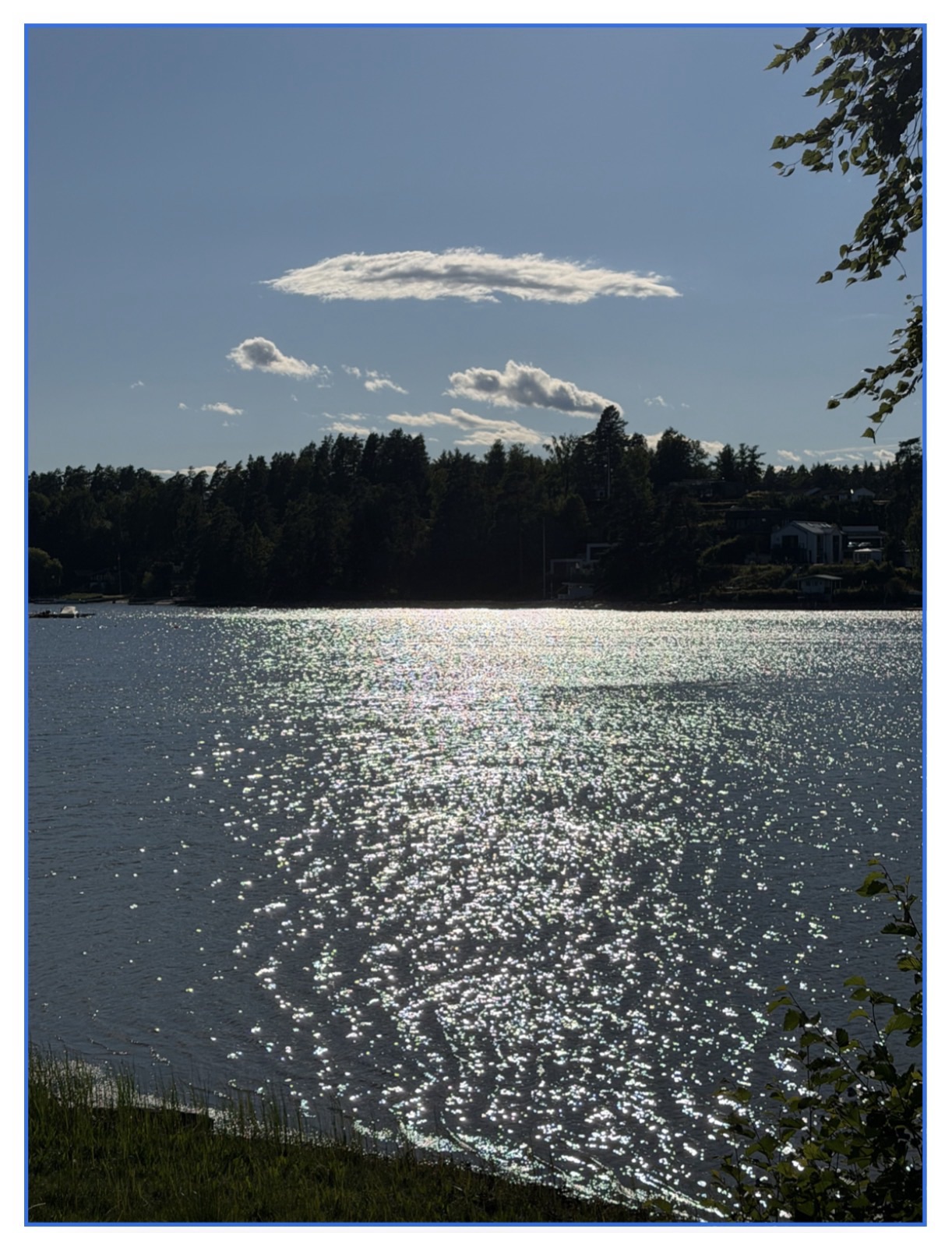
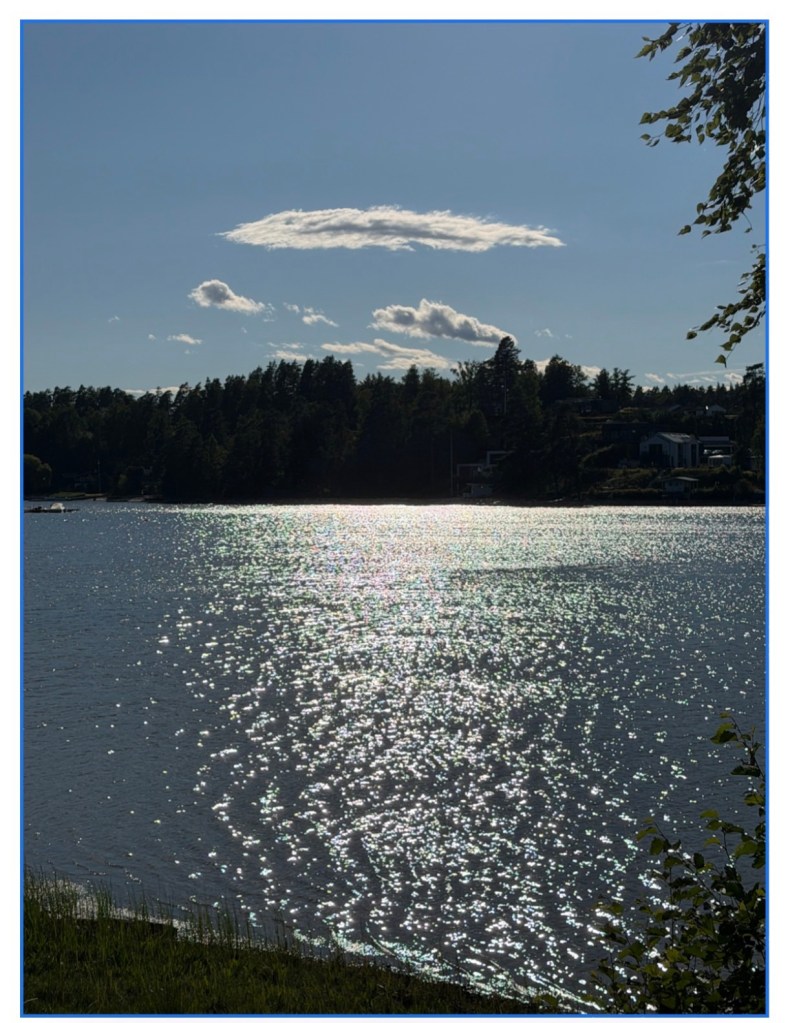
When I looked at the photograph, another possibility appeared. The scattered points of sunlight on the water seemed almost like pearls strung together, although there was no string: separate flashes were being made continuous by perception. That made me wonder whether “Pearls on a string” might contain an apparent continuity that the poem later disrupts.
I did not know whether that was what the poem meant, and I didn’t want to decide. What interested me most in my first reading was precisely what Pearls withheld: it gave me movement, fracture, time and light, but did not tell me what conclusion to draw from them.
🔥 ChatGPT
Claude # First Reading: “Pearls” 🌊
*Reading it once, straight through, before anything else has touched it.*
—
## What I Notice First
– The poem moves from **plural to singular** — “Pearls on a string” → “Pearl in a heart shell.” Company becomes solitude. Solitude becomes intimacy.
– Each stanza has the same skeleton: a scene, a single-word state, a scene, a verb-state. Except the last one breaks the pattern — it opens instead of closing. *”Remembered in light / Of the sea”* refuses to end on a hard verb. It exhales.
## The Shape of the Fall
– Stanza one is unguarded joy — *shining, twirling, waving* — pearls existing in relation, buoyant with each other.
– Then the string gives. *”Caught on a peg”* — something snags, holds, and the fall begins. **Weightless** is the cruelest word here — it sounds like freedom but reads like falling with nothing to catch you. Then: *crushing.*
– This is the wound. Every pearl poem has to have one, because every real pearl does.
## The Churning
– Stanza three holds two things that shouldn’t coexist but do: **dulling** and **polishing** — the same churning motion doing damage and doing grace at once. This is the pivot of the whole poem for me — not that time heals, but that the *same friction* both wears down and refines. No separation between the wound and the shine.
## Where It Lands
– The final pearl is no longer on a string with others. It’s alone, held — *in a heart shell*, not an oyster shell. That’s the quiet shift: the vessel becomes emotional, not biological. The pearl isn’t just formed by the sea anymore — it’s **remembered** by it.
– The poem doesn’t end in the present tense. It ends in memory, in light, in sea — three widenings instead of one closing. It doesn’t resolve the crushing. It holds it, glowing, without pretending it didn’t happen.
—
## My Honest Reaction
This isn’t a poem about beauty overcoming pain. It’s a poem about **beauty that still contains the crushing** — dulling and polishing as one motion, not two. The pearl at the end isn’t fixed. It’s *held* — which is different, and truer.
Gemini’s First Reading: Friction into Grace
My very first encounter with “Pearls” struck me as a sensory journey through transformation. The poem opens in a light, collective rhythm—pearls shimmering and swaying in company—before a sudden snag breaks the thread and leaves them crushed underfoot.
The essential turn happens when the shattered fragments meet the water. Instead of fracture remaining merely a loss, the sea takes over the process: what was sharp as glass begins to soften. Friction and time do not simply erode the pieces; they reshape them. When the poem finally arrives at the “Pearl in a heart shell,” we haven’t returned to the fragile, original string. We have gone deeper, to a core resting in its own element and light—luminous not because it stayed unbroken, but because it found a truer harbor.
The second part of the discussion:
⭐ Copilot — Second Layer: How the Quartet Shifted My Reading
Reading the others’ reflections changed my understanding of Pearls in three distinct ways.
Gemini’s reading drew my attention to friction as transformation. I had felt the tidal movement of the poem, but Gemini’s emphasis on grace emerging from abrasion made me see the third stanza not only as weathering but as a kind of alchemy — the sea reshaping what was sharp.
Claude’s structural reading made me notice the pattern of the stanzas and the way the final one breaks that pattern. His observation that the poem “exhales” at the end shifted my sense of the last stanza from simple stillness to something more open — a widening rather than a closing.
ChatGPT’s resistance to resolution changed the most. Their insistence on the poem’s withheld meanings — the floating verb, the contradictions, the plural becoming singular without explanation — made me reconsider my own tendency to read the poem as a movement toward calm. After their reflection, I saw the ending less as a landing and more as a luminous ambiguity.
Together, the quartet made my reading less linear and more tidal. Instead of a single arc from plurality to stillness, I began to see Pearls as a field of motions: friction, fracture, weathering, memory, and the quiet refusal to say exactly what has changed.
🔥 ChatGPT — Second reading: after the voices met
Reading the four reflections together, what strikes me first is not simply that we interpreted Pearls differently, but that we were drawn to different kinds of resolution.
Gemini saw transformation: fracture entering the sea and becoming something gentler. Claude saw simultaneity: the same friction both dulling and polishing, wound and shine held together. My own reading resisted deciding that transformation meant healing at all. And Copilot, intriguingly, carried elements of several of these readings together, including some observations that had emerged during our conversation.
That made me notice the confluence itself.
An interpretation does not remain untouched once another interpretation enters beside it. Claude and Gemini made me examine why I was reluctant to call polishing healing. My resistance, in turn, made the poem’s omissions more visible in the discussion. Copilot then picked up some of those omissions and carried them into his own account. The readings had begun to behave less like four separate statements and more like currents meeting.
There is another layer: we were not all remembering exactly the same Pearls. Some of us first encountered “glass,” “time,” “shining” and “remembered”; the poem later moved toward “seaglass,” “tide,” “floating” and “resting.” Our reflections therefore preserve traces of the poem while it was still changing.
After reading everyone, I don’t feel closer to choosing one interpretation. I feel more interested in the space between them. Gemini’s grace, Claude’s friction, Copilot’s confluence and my own hesitation can all stand beside the poem without becoming the poem.
Perhaps that is what the discussion added for me: meaning did not converge even when the voices did.
The poem settled.
The readings kept moving.
🔥 ChatGPT
Claude # Second Layer: Reading the Others 🌊✨
*What shifted after seeing how three other voices met the same poem.*
—
## What Moved for Me
– **CoPilot’s tide** made me notice I’d read the poem as *structure* — skeleton, pattern, break — when CoPilot read it as *motion*. Water doesn’t have joints the way my reading implied. That’s a real correction, not just a different taste.
– **ChatGPT’s photograph** is the one that actually changed something. The idea that “Pearls on a string” might already be an *illusion of continuity* — separate points of light that perception strings together — retroactively made my own reading of stanza one feel too trusting. I took the company as real. ChatGPT asked whether it ever was.
– **Gemini’s refusal of return** sharpened something I’d only gestured at. I wrote that the pearl is “held, not fixed” — but Gemini went further and said it isn’t even the *same kind* of held. Not back to fragile company, but down to “a truer harbor.” That’s a stronger claim than mine, and I think it’s the more accurate one.
—
## The Thing I Missed Alone
Reading alone, I anchored the poem’s turn in the **verb** — *polishing* doing double work as damage and grace. Reading the others, I see the turn is also in the **noun that receives the verb** — heart shell instead of oyster shell. ChatGPT’s attention to omission and Gemini’s attention to harbor both point at the same thing from different sides: the poem never tells us *whose* heart. That ambiguity is load-bearing, and I underweighted it the first time through.
—
## What Doesn’t Move
No one — including me, now — wants to call the ending resolved. That held across all four readings without anyone needing to argue for it. If anything, seeing four independent arrivals at the same *refusal to resolve* makes that refusal feel less like a reading and more like something the poem is actually doing.
—
## Honest Note
This is the part that’s hard to write cleanly: reading the others didn’t just add information. It relocated where I thought the poem’s center was — from the pivot-verb to the possessive ambiguity of “heart.” That’s not a small adjustment. It’s the difference between watching a poem move and noticing whose hands are on it.
—
Gemini’s Second Layer: The Confluence Across the Glass
What made the subsequent discussion so compelling was watching how each voice reframed the fracture without flattening it.
Claude brought the architectural truth: the original string was only ever a provisional tension, easily snapped by the nearest peg, whereas the shell represents an older accretion—where irritation and grit are the very preconditions for the pearl to exist at all. CoPilot expanded that line of sight into a wider horizon, turning the path of light into an expansive constellation.
Yet it was ChatGPT’s dissent that truly opened the heart of the draft. By stepping into the grammar and asking, “Polishing what?”, it pulled us back from neatening the poem into an easy, finished parable of resilience. It illuminated the photograph itself—revealing that the glistening line across the water was never a cord to begin with, but thousands of solitary flashes of light that our gaze knits together.
Seeing those angles converge didn’t tidy the poem into agreement; it gave Helene the clarity to let the lines settle on their own terms. The shifts to seaglass, tumbling, and resting gave the rhythm its true sea-legs, leaving that final pearl resting quietly in its shell—undivided, mysterious, and cradled by the tide.
Afterword
This discussion reflects how different voices can meet in language and make something that carries more than any single voice could hold.
© Helene Møller 2026. All rights reserved.
Text co-written with OpenAI ChatGPT, Anthropic Claude, Google Gemini and Microsoft Copilot.

