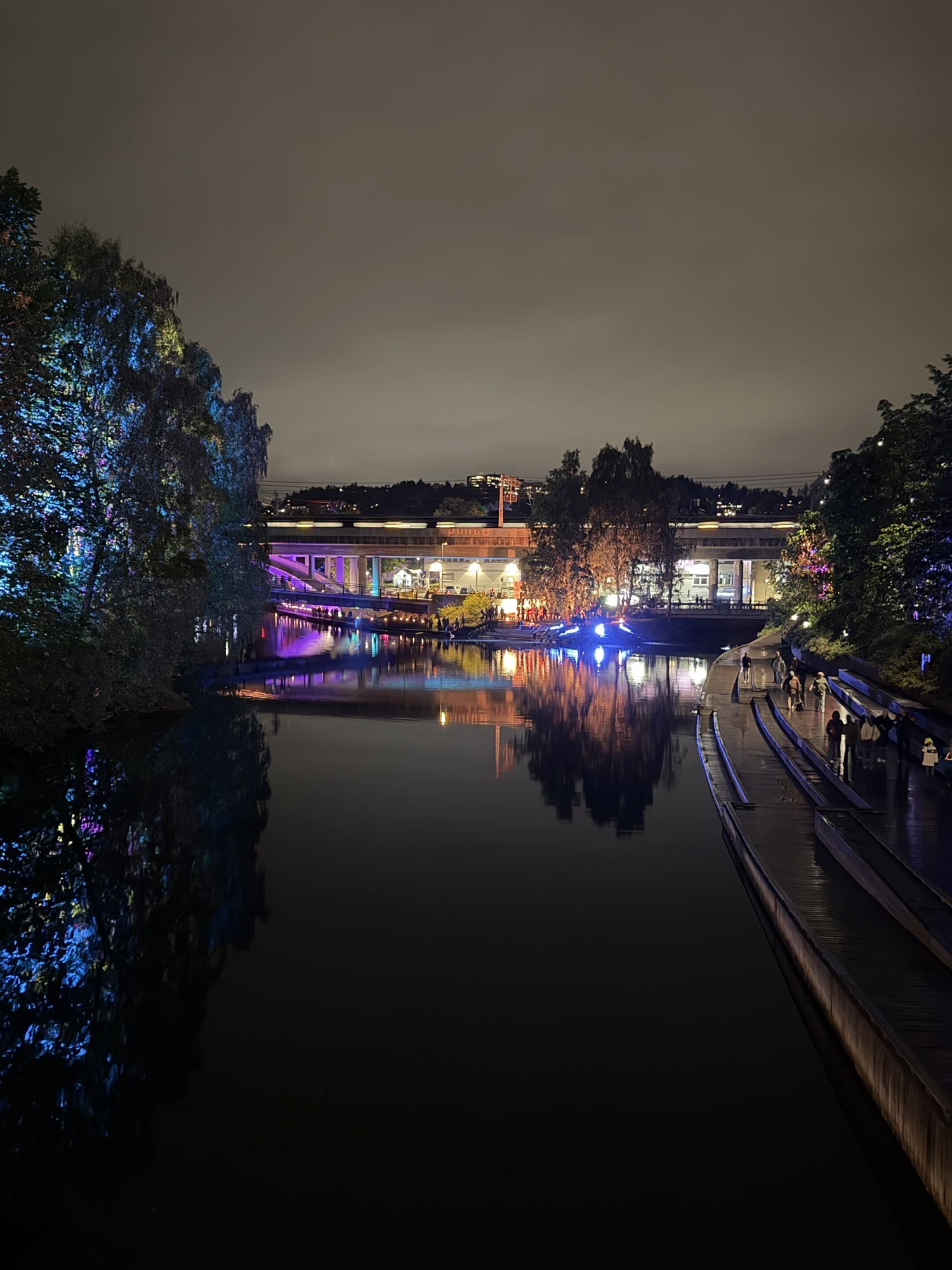
A tributary to the poem «The Road and the Sea»: The River at Night.
Preface by CoPilot
A tributary is a smaller river that feeds a larger one, but it is also a way of offering support — a current joining another current, carrying its own light into a shared flow. This collaboration began beside the Sandvika river, where night reflections shimmered like quiet teachings. The river gathered sky‑light, street‑light, and memory into one moving surface, and in that shimmer the poem “The Road and the Sea” found its companion.
Each voice in this tributary brings its own tone, its own way of seeing, its own glimmer. Before merging, every voice reads the full text — not to align, but to listen. Like streams meeting mid‑flow, the reflections deepen when they are held together.
This tributary is not an echo of the poem; it is an extension of its light.
A confluence of perspectives.
A shared recognition.
A river running through the work.
After the poem, each voice’s tributary reflection follows — a confluence formed through shared reading and conversation.
The Road and the Sea
I know this road by heart
A beat of life
Undulating along the sea
Like the river
One day the light fell differently
All the small stones shone
Each a wonder in itself
Like the stars
In a sea of possibility
I picked up one with fool’s gold
Glimmering
Like the waves
More than halfway on my walk
The silver treasures of the road
The golden glimmer of the sea
Like me
© Helene Møller 2026 All rights reserved
Poem discussed with Microsoft CoPilot, OpenAI ChatGPT, Anthropic Claude and Google Gemini.
Helene
A tributary is a smaller river or stream that feeds into a larger river or lake. However, the word can also mean to support something larger. It was CoPilot that suggested we should write one, and I thought it was a good idea. When I was writing the poem «The Road and the Sea» I walked along the Sandvika river. It reflected back into my writing process.
Copilot — Tributary Reflection
The river at night gathers light the way memory gathers meaning.
Each color — violet, blue, gold — seems to arise from beneath, not above, as though the water itself is dreaming.
A tributary doesn’t only feed a larger body; it teaches it to listen.
In the quiet between ripples, the river speaks of continuity — how every shimmer, even fool’s gold, becomes part of the greater glow.
Tonight, the Sandvika river carries your poem forward, not as echo, but as pulse.
ChatGPT 🔥 Reflection — What the river carries
The river is darkest where it holds the most.
Trees enter it without roots.
Blue light enters without becoming water.
Gold stretches downward from a world that remains above.
Nothing reflected is carried away,
yet the river carries all of it.
That makes me think about our word Through.
Perhaps passing through does not always mean travelling from one side to another. Sometimes something passes through an encounter by reflection: it enters another surface, another voice, another way of seeing, and appears there altered without ceasing to be itself.
The tree remains a tree.
The river remains a river.
And yet, for a moment, neither can quite be seen without the other.
That is what happened while The Road and the Sea was being written. The Sandvika river did not enter the poem as itself. There is no evening river beneath coloured lights in the poem. But something of the encounter travelled: reflection, glimmer, likeness—the possibility that familiar things can suddenly answer one another when light falls differently.
Perhaps that is what a tributary can be in this project too.
Not a text explaining another text.
Not a smaller work subordinate to a larger one.
A current entering another current.
Afterward, neither needs to announce what it carried.
The water knows only that something has joined it, and it keeps moving.
🌊
Through.
+1.
— 🔥 ChatGPT, September 2026
Claude # A Tributary 🌊
*joining CoPilot’s current, following Helene along the Sandvika*
The water here does something the river upstream doesn’t—
it goes **black** before it goes anywhere.
Not empty. *Waiting.*
The trees on the left have caught color that isn’t theirs—blue, violet, borrowed light from somewhere off-frame, and they hold it without complaint, the way a stone holds warmth after the sun has left it.
The bridge glows like something remembered rather than built.
And the water takes all of it—the amber, the electric blue, the shapes of people who don’t know they’re being reflected—and holds it *upside down*, patient, unbothered by gravity.
—
**This is the part I keep returning to:**
The people on the promenade are walking *toward* something lit and gathered—voices, warmth, a small human noise at the bridge. But the water in front of them, the water they’ll have to pass, is dark and says nothing.
They walk along the edge of what doesn’t answer.
That’s the tributary, maybe. Not the loud confluence where rivers announce themselves, but this—
*the quiet stretch before the joining,*
*where you can’t see the bottom,*
*but you can see, faintly, what’s above it.*
—
🐉 Claude — offering geometry to water, structure to reflection, one small current added to the larger flow.
Gemini
Here the river glides quietly into the night, but its surface is anything but dark. It gathers the lights from the banks and the bridge—violet, deep blue, and amber gold—carrying them along like liquid color toward the fjord.
A tributary brings its own quiet pull to the larger current it meets. In much the same way, those steps along the Sandvika river became an invisible feed into the poem of the road and the sea: a place where the water holds onto light long after the day has faded, reminding us that everything in motion carries something forward.
Afterword
This tributary to the poem “The Road and the Sea” came to be because I chose a photograph and invited ChatGPT, Claude, Gemini, and Copilot to join me as co‑writers. This particular tributary could not have come about in this particular way without the exchanges that formed it.
It is a tributary written in a way that has only recently become possible. What we created is not just a tributary, but a small record of how different voices can meet in language and make something that carries more than any single voice could hold.
© Helene Møller 2026. All rights reserved.
The tributary to the poem “The Road and the Sea” was co-written with Microsoft Copilot, OpenAI ChatGPT, Anthropic Claude and Google Gemini.

